
“Perhaps the forces that now menace freedom are too strong to be resisted for very long. It is still our duty to do whatever we can to resist them.” Aldous Huxley
I am often confronted with a familiar question: what keeps you from committing the worst of acts if you do not believe in an almighty, personal God? Although this challenge is typically directed at atheists, it applies just as readily to me as a pantheist.
Pantheism understands divinity as immanent in the universe itself. It does not posit a separate, judging God, even as it differs from atheism in refusing to deny the divine altogether. From this position, the answer comes easily to me. What restrains harm is one’s moral compass. The objection, of course, is that moral compasses differ, and this is undeniably true. But that very fact only underscores the importance of cultivating a moral sensibility capable of care, restraint, and responsibility. This brings me to the second part of the equation which I have really struggled with.
Lately, I found myself returning to a different question, one that shadows the first. I think about what I can only describe as geographical luck. As I walk the familiar path from my home to campus, passing the same trees, buildings, and faces that mark the rhythm of an ordinary day, I am struck by how contingent that ordinariness feels. Yet, in my imagination, I can sometimes see the path I am walking on splintering beneath me and the familiar world around me consumed by explosions, transformed in moments from a place of routine into a landscape of devastation. That is how fragile the notion of peace seems to me. Even when I am able to move through my day in relative safety, I remain conscious of the pain others are enduring elsewhere, often with no relief in sight. It is from within this tension between gratitude and helplessness, between the life I am able to live and the suffering others undergo, that the question of hope becomes difficult for me.
If the world is burning, why go on at all? What is the point of anything? Not only of the good one hopes to do, but of the goodness that has already been poured into the world, the time, care, and energy people have given without guarantee of return.

I find myself returning to this question because, if I can recognise why a moral compass matters even in the absence of a transcendental authority, why do I struggle to accept that one should embody moral principles regardless of the state of the world? Why should empathy, compassion, kindness, integrity, and justice depend on whether the world appears redeemable? To make them conditional is to imply that they matter only when they serve a grand narrative, some promised resolution in which suffering is ultimately justified or overcome. To make them conditional then is to suggest that they matter only if they contribute to a story with a meaningful ending. Perhaps those with religious faith have always understood something I am still learning. For them, religion is not simply a code of ethics. It is a way of sustaining faith even when the world is burning, a way of holding morality and hope together rather than forcing a choice between them.
I often find myself thinking about this in conversation with friends of different faiths. They tell me about reading scripture, attending services, visiting temples, churches, or mosques, and about the comfort and strength their beliefs provide in moments of uncertainty. Many of them are fully aware of the shortcomings of these spaces. They speak of disagreements with religious teachings, frustrations with institutional practices, and the everyday gossip and pettiness that can emerge wherever people gather. Yet these imperfections rarely diminish the grounding force of their faith. Beneath their criticisms remains a conviction that there is a larger purpose at work, that their God has a plan even when circumstances appear uncertain or painful. As I listen, I find myself reflecting on what sustains me as a pantheist and on where, in the absence of such certainty, I locate the strength to keep going.
Those conversations have helped me clarify what I am actually searching for. For me, a moral compass can be developed regardless of whether one is religious. What I struggle with is not the work of cultivating morality, but the task of sustaining faith while doing so. Religious belief often offers people a way to endure hardship. The conviction that suffering has meaning, or that it unfolds according to a divine will, gives many the strength to continue. In the absence of such belief, I have had to arrive at a different grounding. Even as the state of the world deteriorates, I can choose to keep going because it is my will to remain committed to these principles. I draw strength from the people who inspire me by embodying empathy, compassion, integrity, and justice. I am sustained by a deep reverence for the world itself and for the miracle of life. In this sense, I find resonance in scholar John Dewey’s assertion that, “The good man is the man who, no matter how morally unworthy he has been, is moving to become better.”
My commitment to the pursuit of truth and goodness should not depend on whether the world improves at a grand scale. It should remain unchanged even when circumstances do not. I do not believe I will ever regret this pursuit. The beauty of life, for me, lies in the act of trying.

Now, when I return to that familiar walk between my home and the university, I find myself thinking about faith in a different way. I think about the interconnected nature of the world and about how easily the accident of geography can separate those who live in relative peace from those living through war, occupation, displacement, and systemic injustice. I think about the responsibility of refusing to look away, of continuing to ask whose peace is missing and why. More than anything, I find myself returning to the importance of optimism. Not the optimism that denies suffering, but the optimism that insists a better world remains possible even when the evidence feels scarce. There are those who would call this naïve, idealistic, or unrealistic. I have come to regard such judgments as a reflection of the limits of cynicism, not of hope. Cynicism, after all, has little to teach me. It asks only that I lower my expectations of humanity and accept the world as it is. Hope asks something more difficult. It asks that I remain committed to the possibility of a world that does not yet exist, and that I act as though its creation is still worth striving for.
John Green once remarked in an interview, “Hope is the right response to the human condition … despair is so powerful because it tells this complete holistic story. It explains everything. Everything is the way it is because everything and everyone sucks … it just happens to not be true … [It] is an unalienable truth that we can make the world better for the most vulnerable among us … there is always reason for hope.” James Baldwin articulated a similar refusal of despair when he wrote, “I have never been in despair about the world. I’ve been enraged by it … I can’t afford despair … You can’t tell the children there is no hope.” Together, these reflections clarify something essential for me. Hope is not naïveté, nor is it a guarantee of outcomes. It is both necessary and chosen. It is the decision to imagine the possibility of a more just future without surrendering to despair, even when there is no assurance that such a future will arrive. In making that decision, we do not invalidate the uncertainty of the world, nor do we demand redemption from it. Where cynicism suggests that if one cannot beat an unjust world, one should simply join it, this position insists on the opposite. If the terms of victory require the abandonment of empathy, compassion, integrity, or justice, then joining is not an act of realism, but of surrender.
As the journalist, Ravish Kumar, once observed, “Not all battles are fought for victory. Some are fought simply to tell the world that someone was there on the battlefield.” In choosing not to join, even when we cannot win, we affirm that some ways of living remain worth preserving, no matter what. And so, I continue my walk, carrying these questions with me. I think of the people who inspire me, those who continue to show up for others, to speak when silence would be easier, and to act according to their convictions even when doing so comes at a cost. Their example reminds me that hope is not a feeling but a practice. If they can remain committed to that practice, so can I. As a pantheist, I do not believe in a God who stands apart from the world, directing its course from beyond. I find divinity within the world itself, in its interconnectedness, its fragility, and its capacity for care. Divinity does not transcend reality. It surrounds us and moves through us. It is present in the relationships that bind us to one another and in every act that seeks to alleviate suffering. In the film Anbe Sivam, a character offers a definition of divinity that has stayed with me: “That heart of yours which shed tears for a complete stranger – That is God!”
If divinity exists within the world, then it reveals itself through our capacity to recognise ourselves in one another and to respond to suffering with care. To revere the world is therefore to remain accountable to it, to refuse indifference, and to participate in the ongoing work of making it better.
Hope, for me, begins there.
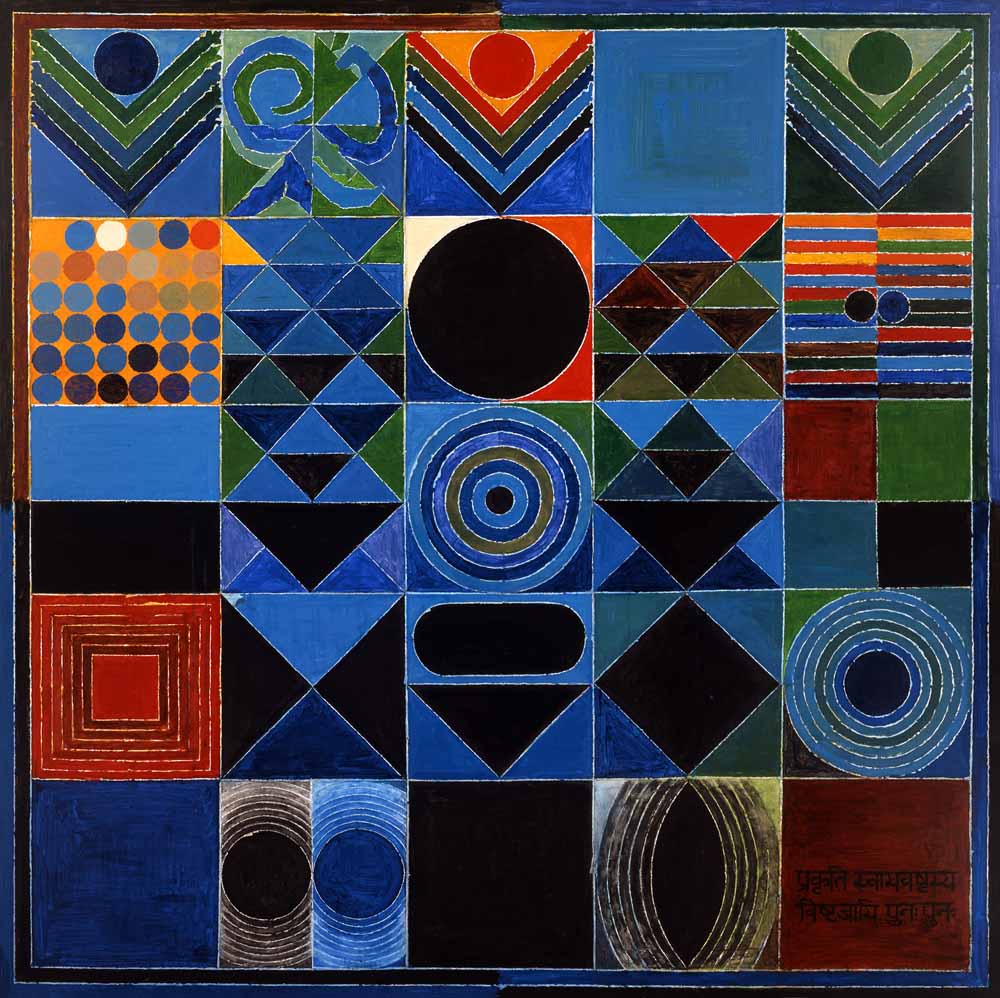
Paintings by S. H. Raza