
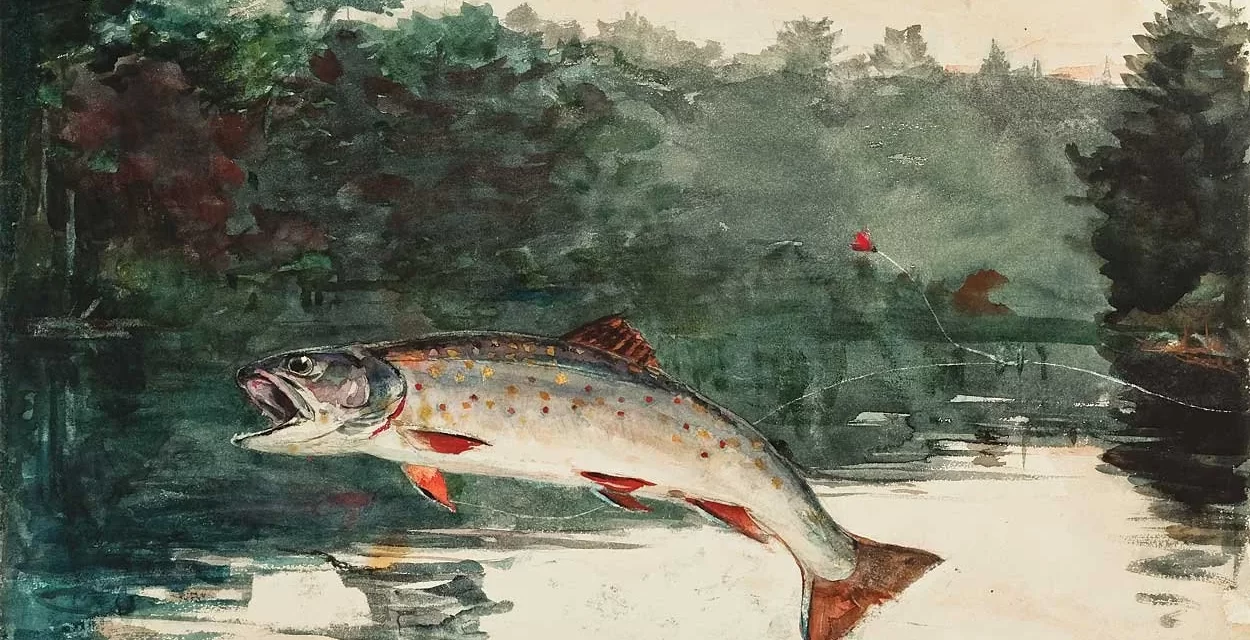
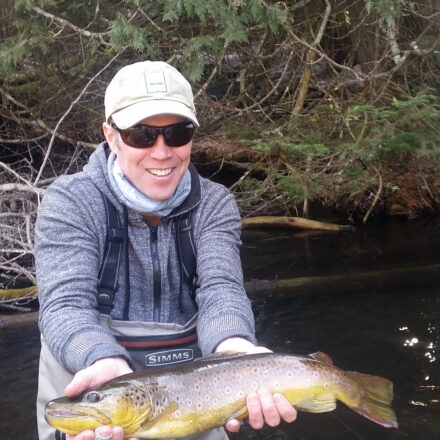
Feel your way into the fish’s mouth. With your off-hand, hold the fly-line in the cradles of your fingers turned upward to the sky like some kind of delicate offering to the saints of rivers. When the take comes, you’ll feel the rod and line tremble as one living whole of which you are a tiny but thrumming part, the take sometimes harder, sometimes softer according to the size and aggression of the fish as the rod bends and the line grows taut and your heart leaps at the exact instant of hooking up, which is a sacred contact impossible to understand, impossible to express. It’s a feeling unlike any other in the annals of your tactile experience—maybe love-making, maybe the sweet spot of a baseball bat or a poetical phrase that comes to you in the middle of the night or some other mysterious and physical ritual where timing and form come together to connect two different worlds or bodies.
The only way you can think of it is in the words of St. Sophrony, a Russian Orthodox priest who founded a monastery in Essex, England and is now a venerated saint. He used the words “holy tension” to describe the proper attitude while praying, a phrase you’ll never forget after reading it once in one of his books for all of the miraculous power and wisdom it holds that surely ripples out to eternity. No take ever gets old, never fails to create a chemical surge deep inside your veins even after all these years; “Repetition is powerless before ecstasy, as Martin Buber wrote.
You’ve never been closer to a single object or tool in your entire life—not the Easton bat you used when you played baseball in college, or the old keys of the typewriter you struck when writing obscure plays that ran maybe for three nights in a tiny theatre light years away from Broadway and maybe ten people in attendance. You have more than enough rods to last a lifetime, but you’ve grown especially fond of your 11’6” Switch-rod Redington makes called a Dually, which you can use with either one hand or two. But these days practically all of your fishing is done with two hands Spey casting and swinging through runs until the rhythm of such swinging has become so much a part of your body as well as the meditative and dreaming state it has grooved inside of you that you sometimes wake up to find yourself going through the motions of casting flat on your back at 3:00 a.m straight from the box.
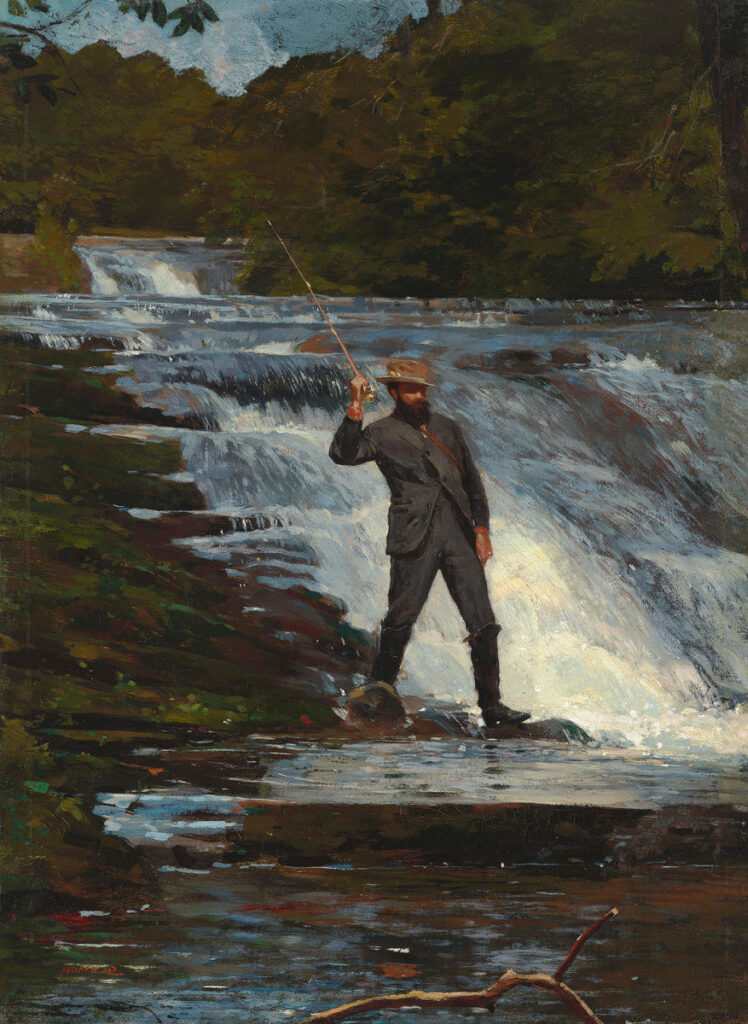
You know there are people who fish more than you do, but you honestly haven’t met them—and this is not something that gives rise to either pride or shame: it’s just become so much a part of your life you can no longer imagine living without it, a strange, private way to foster hope in a broken and polluted world that makes little to no sense whatsoever. The question of whether you’re a great caster doesn’t come up anymore because you’ve come to love the rhythm of it so much it doesn’t matter. There’s just no way. You’ve never practiced anything more in your life, even writing or getting a PhD or teaching almost 30 years. You’ve come to divide your life into two distinct epochs, BFF and AFF, or Before Fly Fishing and After Fly Fishing. Had you grown up in Michigan closer to your paternal grandfather who was a dapper fly fisherman and not on the plains of Nebraska you’re pretty sure to almost certain you would have been a guide and not a professor, though you also realize the futility and stupidity of thinking in such a backward way because you don’t even know how to work a drift boat. You’re in your late fifties, and two years ago you started wearing glasses (not on the water: your prescription glasses are not polarized) because your 20-20 vision faded years ago and you have difficulty even seeing fuzzy clouds in the distance.
You’ve come to the slow, careful conclusion that it’s simply not possible to be lonely on the water even though you fish alone 99.9% of the time; you still wonder how this can be so, for like anyone else you’ve felt lonely in all the usual places: at work teaching undergrads as an obscure and mostly failed writer, even and sometimes most keenly within your own loving family where you have become the eccentric uncle who fishes a lot and likes to drink and writes poetry with no kids of his own. In late middle age you’ve come to accept this dubious role and have even become secretly grateful for it, which is another unexpected gift of getting older like some surprising doorway that keeps creaking open in front of you. After the dramatic breakup of your first marriage in your mid-twenties (she left you for the leader of a boy band while you kept dreaming of making it big as a playwright while working part-time at UPS loading trucks) you went on a seven year spree drinking and carousing before finishing your dissertation and getting your first and only teaching job at a small liberal arts college in the middle of Michigan, a period in your life that you look back on with equal parts horror and astonishment for surviving it at all. The first semester in the faculty dining room you saw flat out, hands-down the sexiest, best looking woman you had ever laid eyes on in your entire life only to find out that she was married, though later she would tell you from her own perfect cupid bow lips that her marriage was on the rocks and that she was interested in reading your plays because she was the costume designer in the theatre department. Then it was game over as she and you embarked on the wildest love affair you could have ever possibly imagined, which continues down to the T of this exact day 25 years later even while writing this as you hear her moving around upstairs, which has the slightly discomfiting effect of tugging at your loins at the sound of every footfall.
You don’t have a nickname for your switch-rod, but you do for your pickup, which you call the fish truck for the simple truth it conveys without any undue adornment. It has just about everything you need for a sudden trip or overnight stay somewhere up north: bags of peanuts, foam roller, lays upon layers of shells, shirts, fingerless gloves, stretch bands, bog boots, flip flops and rod cases, rolls of KT tape, fishing books, reading glasses, water bottles, reels and rod tubes, head lamps, coolers, bug spray, sun screen, and little tubes of Chapstick that are way past their expiration date along with a huge Lions’ water mug. You rubber neck at every body of moving water you drive by across the emerald state of Michigan, even if it’s a slip of a stream no wider than the span of your own outstretched arms—and sometimes you double back to park and check out the that braid of water that’s at once so innocent and so enticing you wonder if someone will pinch you out of reverie. Fishing has become the throughline and bedrock of your entire life and a way to connect with all of creation, even going back to when you were just five years old staring with wonder at the glistening minnow cages off the dock of your grandparents’ cabin on Glen Lake in northern Michigan with constant thorns of water lapping up against the posts.
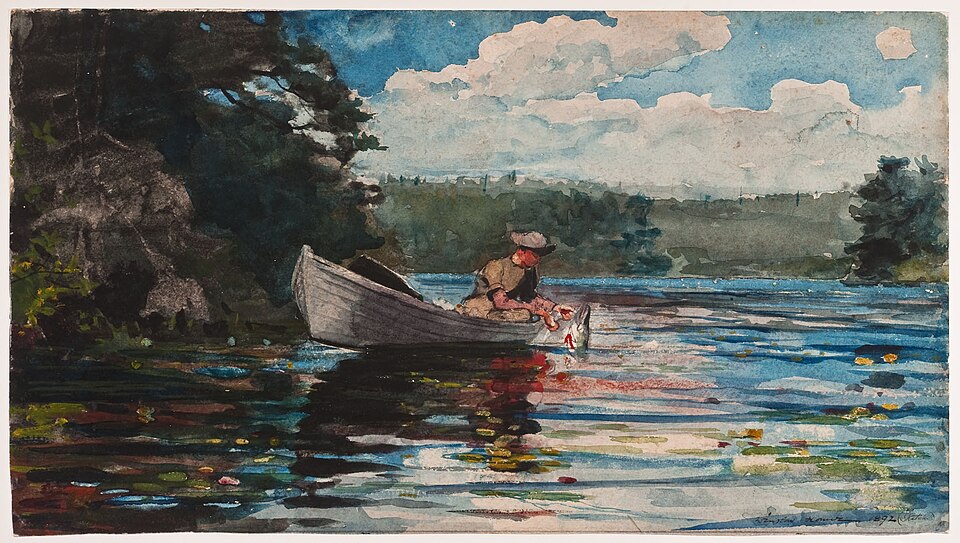
You’re slowly beginning to realize with utter astonishment tinged with embarrassment that your entire life has been refracted through grace, though you shudder at the towering truth of this fact and your own crude unworthiness, especially fond beyond any reason you can explain at the time you were broke and tried to sell a microwave at a pawnshop in Omaha only to have the owner say, “Listen, buddy, I’ll give you five bucks for it” before you walked out of the shop on a cold day in January on Farnam Street cradling the microwave in your arms like the child you would never have. Stardust and a few worthless pinches of salt thrown into the wound, personal futility perhaps the truest things you know. You fish every day in summer except Sunday, the sabbath holier than ever by refraining from doing what you love to do most in this world. You’re a first grader in learning Russian because you want to read and understand The Brothers Karamazov in its original so you can dive even deeper down into its fathomless depths, though you know for corn pone certain that you will never reach the bottom or the heights of its shattering greatness nor ever possibly master this beautiful language.
You wonder if you’ve put all of your love and eggs into one basket that contains fishing and the insane love and attraction for your wife, which borders on one of Beckett’s favorite words, uxoriousness, or excessive love of one’s wife, but since converting to Christian Orthodoxy several years ago you have also come to cherish services at a monastery run by Romanian nuns in the southern part of the state so much you hardly know what to say. More and more each day you find yourself living in a private condition of awe, which is triggered by the smallest, strangest things: grief at the sight of a tiny baby mouse in the basement who’s not going to make it, planting pots of micro greens in the front and back yard, fishing (again) and some days where your only goal is to catch one fish and then go home because one fish is just right and probably always right. You published a novel under a stupid and pretentious pseudonym and have done nothing to promote it, which you only mention because writing it floored your very soul as you begin to truly wonder if maybe most if not all the deepest bouts of feeling go totally unnoticed and unchronicled, like the lives of the rarest wild animals who are hardly if ever seen or saints on their knees during their darkest trials.
Poetical moments seem to happen constantly these days, which causes you to truly ponder how much longer you have to live, but this doesn’t make you sad, just wistful somehow and like one of Misloz’s earlier poems, “I ask in wonder, not in sorrow.” You’re like the main character in Clarice Lispector’s The Hour Of The Star who says somewhere, “I’m going to miss myself when I die.” A dragon fly hovering at the end of your rod tip, two fawns sharing the river with you about ten feet away—Tina’s lettuce light laughter and how she lifts her chin in a way that makes you want to take her in your arms every single time as if it were the first time and it is and it is and it is, smoking a cast and getting your fly right where you want it fifty feet away in a tight spot the circumference of a tennis ball, flubbing a cast and snagging of all things a rubber boot that you reel in with dismay as you have come to think of your switch-rod as a new kind of string theory as you rarely can see the fish move for your fly anyway, your old Dad you have come to call the Hungarian Zorba the Greek for the way he is constantly hugging as many people as he can, the gourds you’re growing in the backyard and how you always think of the old peaceful Mennonite women who used to sell them at the farmer’s market even as her very presence gave you hope and a kind of shy and secret joy. Be thou now my mirror unto eternity, which is an odd and formal phrase you have started to repeat daily for yet another completely unknown reason. And yes, sometimes in the classroom when a young person discovers for her or himself the profound, life-changing potential of literature even as it happens right there in front in the dawning light of their beautiful faces. The only person you could possibly envy is someone who fishes more than you do, but you haven’t met this person yet—and even if you did, you know the envy would disappear because there’s no room in your heart for it anymore.
Feel your way into the fish’s mouth even though you’re sixty feet away—then with the rod and then with the cast and then with the swing as the fly line and leader sweep out before you in a beautiful arc and parabola that you can feel all the way down to your toes. St. Sophrony wrote that the spiritual life is like a sphere, and like a sphere you can come into contact with the Divine any place on it or at any time in personal or world history, bar none. Hold on for dear life when the fish takes because dear life is exactly it takes and what connects you. Then cast again and again until you can’t anymore. Then maybe get down on your knees and lift your arms to the sky and say, Thank you, thank you, Спасибо. I don’t know how much more beauty I can take, Lord. But I am more than willing to try.
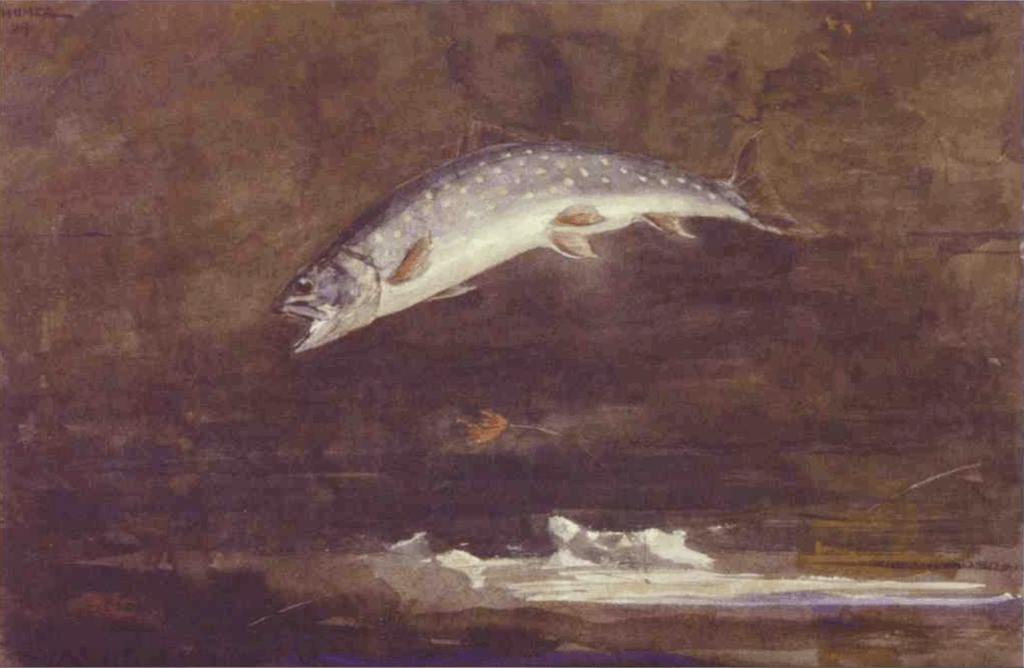
All illustrations by Winslow Homer.




First of all, I did not mean to leave half a star. It keeps doing that to me. Although I didn’t mean to leave one star only. The reason I did is because, although I absolutely resonate with the feelings you talk about in your essay, I can’t get on board with you feeling them while you’re killing something. I just don’t get it.
This is a stunning essay: beautiful, passionate, and full of holy tension. I marvel how Vivian braids the natural world with his personal life. And thank you to editor Laura Grace Weldon for including the wonderful illustrations by Winslow Homer.
An exceptional piece of writing that beautifully and honestly connects two different worlds. An inspiration to read The Brothers Karamazov, too. St. Sophrony’s observation that the spiritual life is like a sphere, and like a sphere you can come into contact with the Divine any place on it or at any time in personal or world history is a revelation. Still, it remains confronting to me to think this includes the killing of another living creature, even one as seemingly insignificant as a fish.