
Northern light filled the Gilded Age Harlem apartment I grew up in, perfect light for painters, and because it was the 1950s, our walls were filled with my mother’s beloved prints of Impressionist paintings. I see now what a wonderful stage setting that place was for art: high ceilings; French doors between the living room and dining room that let in more of that cool, clear light; a view of the George Washington Bridge; elaborate parquet floors that needed regular
noisy polishing; a graceful archway off the large foyer filled with books and a well-worn encyclopedia of over thirty volumes.
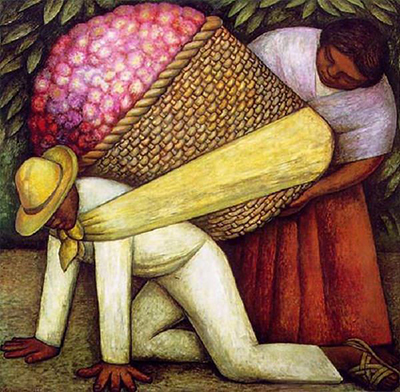
But pride of place in our forest green, gold, and deeper red living room was given to Diego Rivera’s 1935 “Flower Carrier” framed in large, deep coffee-colored wood that made you feel you were looking into another world. It was totally unlike the other reproductions and hung opposite a blond Scandinavian-style Hi-Fi; those two seemed to anchor the room in a realm of culture.
In the painting, a young campesino whose face is shaded by a straw hat has an enormous flower basket on his back while a woman who might be his mother seems to be helping him rise from the ground with his burden. It’s as stark as it’s beautiful, with a small palette of colors: red, lilac, yellow, brown, black, green. And the woman seems not just strong, but tender and loving.
This work was so unlike the other prints in our apartment that it puzzled and fascinated me. If the man was selling flowers, why was the basket so large and apparently so heavy? Who in fact was the woman helping him? Where was this taking place? I didn’t ask my mother any of these questions in that naïve, obtuse way which hits us many years later as adults.
My mother, as elegant and witty as Claudette Colbert, could contemplate this artwork for hours, sitting back in one of the fat fifties armchairs, its forest green upholstery shot through with golden threads, smoking her habitual Pall Mall. She told me that this painting gave her strength. She didn’t say more. She didn’t have to.
I knew enough already at a young age why she needed strength: The Nazis had stolen her home, her country, everything she owned, murdered her parents and most of her relatives, beaten her, shipped her from one concentration camp to another until she ended up in a slave labor camp at the end of WWII–and survived only because of luck and daring. The Americans were rumored to be near the heavy-bombed city in eastern Germany and one morning the camp gates were open, the guards had vanished.
The other women were afraid to venture out. But she wasn’t, and she learned not long after being rescued by young American soldiers that the women who stayed behind had been taken on a forced march by Volkssturm, the ragtag late-war Nazi militia, and murdered by hand grenades in a sports field.
I have a print of “The Flower Carrier” in my study and what I see in it now is my mother as both figures, both burdened and lifting the burden, the survivor, the woman who had lost everything yet could still love life, art, opera, ballet, classical music, laughter, politics–and her children. But I also see more than that: I see Christ and his cross in this painting, the suffering of all the world in that basket, Christ helped by Mary in a radically different Pietà. Because here he is alive.
Did my mother see that too?
The Flower Carrier, Diego Rivera, 1935 (Mexico) hangs in The San Francisco Museum of Modern Art: