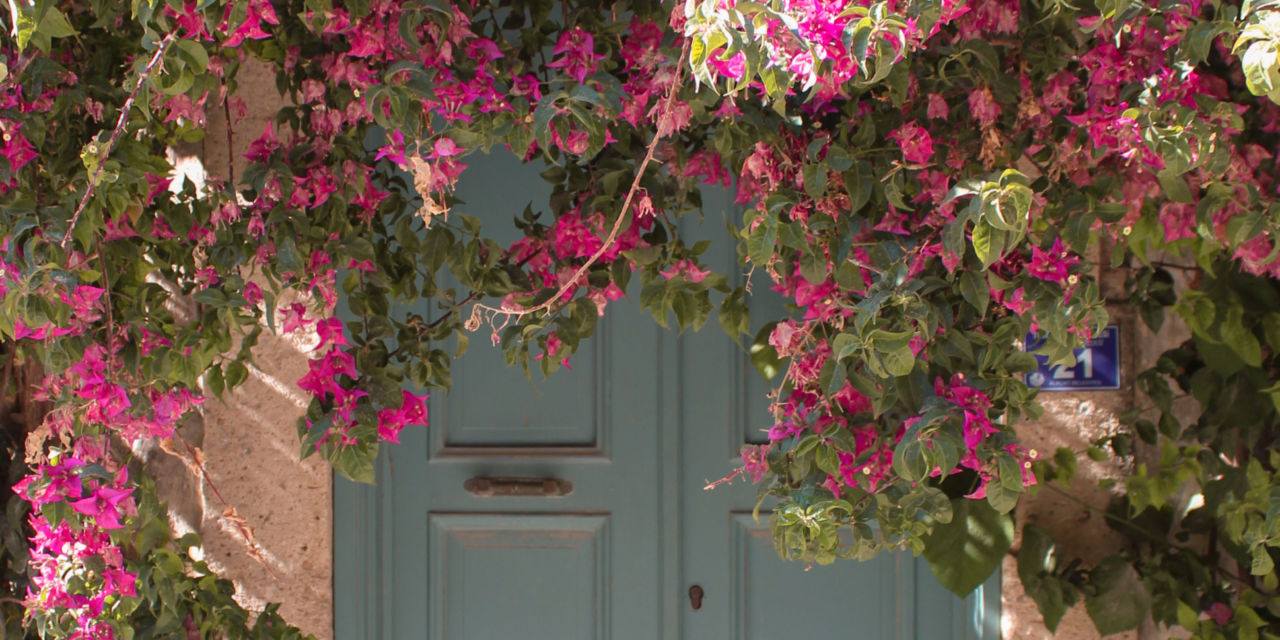
On the corner of Market Street, stood a yellow house with a door that was always shut, always watching. Nobody knew if anyone lived inside, and no sound ever came from within. The top half of the door was made of glass, shrouded by thick white curtains that no one could see through. The only sign of life was the blooming bougainvillea creeping all over the yellow walls. In summer, it would grow wild, starting to spill over the door like a story that had begun but hadn’t found its listener. Despite its mystery and lively brightness of colors, the house went largely unnoticed by those who lived on that street, blending quietly into the background of everyday life.
Ishar, the magazine vendor, would often pause under the hanging bougainvillea during his morning distribution rounds on his bicycle—taking a breather from the muggy August heat that made one feel laminated the moment they stepped outdoors. That month was barbaric in this part of the world, and calling it “August” felt like a contranym. Ishar had created one of the most unique jobs for himself in the late 80s. Every month, he would buy the latest editions of all kinds of popular magazines and, like a walking—cycling—library, deliver one to each house on the street that subscribed to his service. The next day, he’d return to collect it and let you choose another. The magazines ranged from hard-nosed, boring ones like Business Universe to the more riff-raff ones like Cine Glitter, and the ever-popular People’s World, which featured an agony aunt column where real people asked life’s big and small questions and got duly answered. He carried the magazines—neatly stacked like in a library—in two large canvas bags that hung from his bicycle’s handlebars. And he’d let you dig into those bags and pick one out for yourself.
On this Tuesday morning, however, Ishar did not come. The Milkar family, his old patron, had to make do with the same magazine for another day— which was fine, really, since Tuesday wasn’t an eventful day anyway. It was, in fact, the most boring day of the week. Monday still carried a trace of fresh start energy—how bad could things get? But by Tuesday, the week had sunk its teeth in and wasn’t letting go. So reading the same old magazine again couldn’t possibly make it any worse.
Ishar was a compulsive writer in a world that had forgotten reading books. His own books didn’t sell much, and the magazine library was his way of staying afloat—while still staying connected to the written word. Some writers have to carve out time for writing. But for Ishar it was more primal, like the call of nature—sudden, undeniable and impossible to ignore. Not once in his life had he failed to obey, no matter the hour. Once he was jolted awake at 2 a.m., when his entire neighborhood lay in darkness due to an electricity failure. After splashing water on his face, he rushed out to the courtyard, gathered what scraps of moonlight he could find, and began scribbling on the verandah with chalk. It wasn’t just a few lines—it was a full story, sprawling across the floor, only to be washed away by rain a few hours later. You could say Ishar wasn’t separate from his pen. Just as a pen begins to write the moment you command it, so did he—except unlike most pens, his ink never dried. He was a gentle, humble man, always bowing in greeting, always speaking in a kind voice. And rightly so, as he would say—if a pen stands too proudly upright, it will never be able to write. The pen must bend, must bow to meet its beloved paper in the act of literary consummation. Only then are beautiful creations born.
The next day, Ishar still didn’t come. The Milkar family remained unbothered. Many times, even when Ishar was right at their door, the whole family would be scurrying around, trying to locate the darned magazine—and failing. After patiently waiting in the sweltering heat, with his cheeks flushed and sweat dripping like molten wax from a burning candle, someone would finally step out and inform him that they’d decided to keep the same magazine for another day. Ishar never minded. Quietly wiping the sweat off his forehead with his red-and-white cotton parna, he would simply nod and say he’d come back the next day.
The Milkar household, especially during summer holidays, ran a full-blown circus. The parents were too laissez-faire, and the three kids were allowed to do whatever they pleased within their modest means—which included, for instance, spilling talcum powder all over the bedroom floor so they could take turns skidding and slipping around barefoot, or hurling orange slices to bedroom walls to see if any slice would stick. The house was always a mess. Dust gathered under the beds, and once you removed your slippers to get on the bed, they’d somehow end up under it—never to be seen for weeks. Laundry was never put away unless guests were expected and cobwebs were only cleared at New Year’s. Though the house barely had enough space for everyone, a dedicated cupboard existed solely for Daddy Milkar’s liquor bottles, which the children were told were his “medicine” for a chronic invisible ailment. A lot of wildlife thrived there, too— multiple lizards darted across the walls like cars on a highway, a parrot in a cage occasionally mimicked human words, a stray dog named Jackie lounged around, lice resided in the hair of two of the daughters, and armies of cockroaches made their home in the kitchen cupboards. Yet, there was an emphasis on aesthetics: ceramics, indoor plants, brass lamps—anything that made the house look beautiful for guests and masked the biodiversity lurking in the background. In this very full, nearly wild habitat—buzzing with noise, belongings, needs, and emotions of five humans—it was perfectly understandable that something as insignificant as a magazine would go missing.
Another day passed. Still no sign of Ishar. No new magazine.
The Milkars finally mentioned it at the dinner table, which featured the usual spread of green and black lentils with flat bread—what they jokingly called the national anthem, like a daily ritual at the school assembly. Some cucumber sticks and raw onion slices dusted with rock salt accompanied the meal, to beat the heat.
‘Did Ishar not come again today?’ Khoji, the youngest one, inquired in a concerned voice.
‘He must be sick or something. It’s very hot. Eat your dinner,’ Mrs. Milkar quickly brushed her daughter’s concern aside.
‘What? We need a new magazine,’ Khoji said, trying to cover up the fact that she had actually started to miss Ishar and was worried about him. But she thought everyone would laugh if she said that. Khoji had always been fond of him and would ask him all kinds of questions that everyone else in the family usually got annoyed by—but Ishar always had the time, patience, and answers for her. The last time she met him, she had again asked a lot of questions, but this time he didn’t give any answers.
‘Why does she need a new magazine? She’s so little. I bet she’s reading those agony aunt columns in People’s World,’ her oldest sister, Didi, interjected mockingly.
‘Well Daddy reads them too, so why can’t I? I’m almost a teenager now,’ Khoji said with sheepish eyes, since she wasn’t allowed to read those things by her father.
But everyone was in a good mood that evening—the electricity had stayed all day, and there was no school the next morning. So, no one said anything to Khoji. Soon it was time for their next daily ritual: a game of carrom, with mango milkshake glasses that Mrs. Milkar was happy to make for everyone.
Khoji didn’t know where Ishar lived, but she had often seen him standing outside the yellow house under the bougainvillea when she cycled past on her way home from the playground. So the next day, when she was done playing with her friends, she decided to stop by that house on her way back.
It made no real sense to look for him there—if he had come that far, he would’ve come to Khoji’s house to deliver the magazines too. Still, she got off her bicycle, parked it to the side, and looked around. With no sign of Ishar anywhere, she walked up to the door and knocked. She had no idea why.
Nobody answered.
She pushed the door a few times and, to her surprise, it opened. She wasn’t sure what was happening, but something inside her was leading her into the house. And there she was—walking through the hallway of a house that had supposedly remained closed for years, maybe even centuries, if you believed the spooky stories.
Inside, she found stacks and stacks of People’s World magazines, piled almost to the ceiling. She wandered through the serpentine alleys between those stacks and noticed that the dates on the magazines stretched far back in time—and forward, years and decades into the future. She kept walking, feeling like an archaeologist inside an ancient cave, in that shockingly vast house that seemed so small from the outside. Eventually, she saw Ishar sitting on a chair beside an old lady, who wore a long, flowery maxi dress, reclining on a comfortable couch. Khoji froze. Scared, she stayed hidden behind a pillar and listened to what was being said. Ishar was asking question after question, and the lady was answering—on a variety of topics: relationships, marriage, parenting, finances, careers… basically, everything on earth.
Right away, Khoji knew this had to be the Agony Aunt whose column she’d been reading on the sly.
The air was full of strange smells—of freshly printed paper and ink—that tickled Khoji’s nose and made her sneeze. She paled.
The Agony Aunt smiled and said, ‘Don’t worry, child. I know you’re here. Ishar has told me all about you. Come, sit next to me,’ and she patted the seat beside her, sending dust particles swirling in the stream of sunlight that pierced through the room.
Khoji did as she was told. As she stepped out from her hiding place, all her fear melted away. Though she was still perplexed by all she had seen and heard, she stayed quiet for a few moments while both Ishar and the Agony Aunt looked at her with warm, knowing smiles.
Finally, after a long pause, Khoji started to fire questions, ‘Who are you, and why do you have all these papers here? How do you know the answers to all the questions? And what is Ishar doing here? And how do you have magazines from the future? And where have—’
‘Slow down, tiger!’ Agony Aunt chuckled as her big green eyes twinkled behind round, metal rimmed glasses perched on an even rounder face. Her soft, big belly and double chin bounced as she breathed. Khoji thought she was like a big bowl of cookie dough—soft and sweet— wrapped in a muslin cloth with flowers on it.
Khoji smiled and turned her head toward Ishar, noticing that he looked very different—almost radiant, not tired at all, and very happy. This was never how she had seen the poor man who was way older than her father and still cycled from one house to another every day for many kilometers in this angry summer to earn his bread.
‘And where have you been the last few days, Ishar?’ Khoji finished her question.
‘Okay, first things first—who am I?’ Agony Aunt put her hand gently on Khoji’s shoulder and started to answer, ‘Well, I…am the answer. See, most people in the world are questions; they even look like question marks with a round skull, a straight body, and life dripping off the bottom. They are always wondering what is happening, why it is happening, and why it can’t happen any other way. So I decided to be their answer,’ she explained.
‘So you aren’t a person? How can I hear you, and how can you touch me then?’ Khoji asked, looking towards Agony Aunt’s hand on her shoulder.
‘Just like you can listen to the wind, and the breeze touches you, my dear. Ishar isn’t one either. He is a carrier of my messages. You need a medium for voice to pass; he is that.’
‘And how do you know what to say to so many people?’
‘Oh, that’s easy. I have a lot of data. I keep getting similar questions over and over again— sometimes whispered, sometimes cried out. And someone’s question becomes another one’s answer. In agony we are all connected. And this collective knowing of everyone, a slice of which lives in each of us, is what people call higher intelligence. Though I’ve never understood why they call it higher—I don’t live on the second floor! I’m not above anyone here. I’m just… here,’ Agony Aunt said, placing her hand to feel Khoji’s heartbeat.
‘You are funnier than most, though! So if the questions repeat, you are also able to predict what will be asked in the future and already have the answers—and hence you have all the future magazines here too?’
‘That’s exactly it, my child!’
‘Why is the door to your house always locked?’
‘Well, you came in, so it wasn’t locked then. Everyone just assumes it’s locked or that a ghost lives inside, so they never dare to come in. You’re the first one who dared. I’m too glamorous to be a ghost, don’t you think?’
‘You definitely are! Well, I came because I was concerned about Ishar. I wanted to make sure he was alright and if he needed any help.’
‘And that very concern and courage to follow it through is what leads one to all the answers.’
‘So, you’re saying that whenever I have a question or problem in life, I can just come through this door and find all the answers?’
‘Yes, that’s it! You can certainly do that!’
‘Okay then, am I a person or not?’ Khoji asked.
‘What do you think?’ the Agony Aunt asked back.
’Well, if you and Ishar aren’t really persons, then maybe I’m not either. But if I’m not a person, then I wouldn’t have any problems or questions, right?’
‘Aha! There you see the magic of higher intelligence working for you—making you answer your own question!’ Agony Aunt smiled. ‘Indeed, child, if you truly understand and remember that you are no more than an occurrence in space and time—and a brief one at that—you won’t cling to the problems you call problems. The answers will come to you naturally too, so long as you keep your ears open.’
Khoji turned toward Ishar, who had been quietly enjoying the exchange between the two, and asked, ‘Ishar, why haven’t you come to our house these past few days?’
‘Well, Khoji,’ Ishar began, ‘the last time I came, your questions had grown—from simple curiosities to seeking the deeper meanings, the whys behind everything. My words would have come in your way, so I wanted to bring you to the source of quiet knowing inside you. And to let you realize that such questions may not have linear answers, or no answers at all, but they will keep guiding you.’
‘So you both knew I would come looking for you?’
‘Exactly,’ Agony Aunt replied, wrapping her arm reassuringly around Khoji’s shoulders. ‘You noticed the signs and listened to your heart. That’s exactly how to find what you seek.’
‘Will Ishar come back to deliver magazines?’
‘Of course,’ Agony Aunt laughed warmly, ‘until he finds someone else thirsty for answers—and wants to lead another horse to water. But remember, he can’t make the horse drink!’
‘Come on, Khoji, it’s late!’, Mrs. Milkar called from the kitchen, ‘You’ve slept long enough. Go answer the doorbell—my hands are full. It’s probably the milkman; everyone else has gone to the market.’
Khoji rubbed her eyes groggily and put her glasses on. ‘What time is it, Mama? I was having the strangest dream about that yellow house,’ she murmured to her mother, who barely heard her.
At the door stood Ishar, back to his tired and sweaty self, with his bicycle loaded with magazines. He was telling Mr. Milkar and Khoji’s siblings—who had just returned home—about how he had been away for a few days helping a horse find water.
‘Helping a horse find water? Is that one of your new stories, Ishar?’ Mr. Milkar smirked as he rummaged through the canvas bags for the latest copy of People’s World.
‘Oh, sorry, I was mumbling. Maybe that will be my next story, if you say so,’ Ishar said with a wink at Khoji before speeding away on his bicycle.
On his way, he stopped by the yellow house. The bougainvillea had grown a lot, now covering almost the entire door. Ishar trimmed it carefully, making sure the door remained accessible.