
“It isn’t easy for me to admit that I believe each of us has a higher, radiant body dwelling in another dimension, and that when we write to the soul we are, in fact, invoking it. Yet this is truly what happened in my life.” the author
Isis, radiant goddess of ancient Egypt, was the beloved of Osiris. Out of envy, her brother Set slew him, hewed his body into fragments, and scattered them across the earth. Yet with inexhaustible love and unyielding magic, Isis wandered the land, weeping, chanting, flying—gathering each broken piece. With the breath of her enchantment she drew the body whole again, restoring him not to mortal life, but to a throne in the underworld. From that resurrection she conceived their son, Horus, destined to rise against Set and avenge his father.
With this Egyptian myth, memories from fifteen years ago flare to life. I recall when my own Osiris had been torn apart—my spirit, my future, shattered into fragments. I believed all was ended. My son was only two, and each day he watched his father seize any excuse to descend upon me. One of my so-called crimes was carrying the trash to the metal bin at the corner before he could examine it. He sifted through the refuse for evidence of my unworthiness: “Show me how thickly you peeled the eggplant and potatoes. Did you throw away a rag that might still have served? Did you discard a bottle with a few drops of oil clinging to the bottom?”
When I set the table and served a meal, I counted myself fortunate if the plate did not explode against the wall in ten shards. He despised me, and he despised my books. When he struck me with fists, with a pull-up bar, with a belt, my tiny son would rush forward as if his small body could shield mine. With bruises on my face, I would step out to buy fruit, vegetables, bread; the neighbors stared in astonishment. Surely they wondered why I remained in that house, enduring such torment. At last one asked, “Don’t you have parents? Give me their number, and I will call them to free you from this tyrant.” I offered only a counterfeit smile, averted eyes, and whispered, “It’s nothing.” For I knew my family saw nothing wrong in such treatment. To them it was natural that a woman should not study, should not read, should not practice yoga, should not seek silence. In their eyes, even my striving toward growth marked me as suspect.
To them I was suspect. For whom, they wondered, was I keeping myself alive—bright, resilient, unbroken? My husband beat me for that very reason. He saw my determination to flourish as treachery. In his eyes, and in the eyes of both our families, a woman was destined for ceaseless service to the household, without even the shadow of individuality. To step beyond that law was, in their judgment, to merit death.
At that time I was pursuing a doctorate in Persian literature. My dissertation was many-sided: I was required to place Ahmad Shamlou, the great modern Iranian poet, beside Nizar Qabbani, the towering contemporary Arab voice. To analyze them I had to wrestle with the thought of Friedrich Nietzsche, Louis Althusser, György Lukács, Erich Fromm—and the psychoanalysis of love itself. The burden was immense, the time meager. The university, accusing me of negligence, threatened expulsion. They demanded absolute devotion. When I pleaded for a leave, they refused, saying I had already lingered too long. They fined me. And at home my husband struck me again—for daring to cost him money.
I had reached a dead end. The aircraft of my life had crash-landed on the lethal summit of K2. Around me stretched nothing but snow, ice, and furious storms; I stood on the brink of freezing to death. What could I do? My only solace came from writers like Franz Kafka and Louis Althusser, whose unflinching letters spoke nakedly to the wounds of my soul. Both had felt estranged from their mothers, and both had dared to name it without fear.
In those confessions I found a fragile calm. At times I fled into their words, yet I knew they were not enough to keep me from turning to stone in the cold. For years I had lost all faith in religion; instead I had sought refuge in the great authors—Camus’s The Fall and The Stranger, Kazantzakis’s The Last Temptation of Christ, the poems of Hafez. But in that season of torment, refuge was not enough. I needed a solution, a hidden door into paradise. How could I gather the scattered pieces of my own Osiris—my love, my faith, my hope, my courage? One sentence from Dostoevsky accompanied me through those nights of torture: “Even in prison a man can create for himself a life of great intensity.” A voice deep within told me this was the pure truth. I would read, feel myself briefly lifted, only to be hurled back into the storm—until at last that day arrived.
My husband was asleep when his phone began to buzz again and again. I reached to silence it so my son would not wake, and my eyes fell upon a torrent of sexual messages with other women. Before I could set the phone down quietly, he stirred, assumed I was spying, and descended on me with ferocity. He tore the clothes from my body. With trembling hands and a pounding heart I dressed again, gathered my little boy—startled awake—and wandered the streets for hours, weeping without direction. My life seemed finished. Then a thought seized me. I left my son with my close friend Maya, telling her a lie—that I had an appointment with a psychiatrist. I returned home and turned on the gas. As the heaviness thickened in my head, thoughts rushed in, and before me rose the image of my son’s smiling face.
I was ending myself. As Arthur Schopenhauer wrote, suicide is like leaping out of a dreadful nightmare into peace. But what of my son? What could replace the embrace he would be denied? The shelter I had never known was about to collapse upon him as well. How could I leave him with that father and not tremble for him? From deep within, a voice quivered: You cannot end this way.
Dizzy, I rose, shut off the gas, opened the windows, and fled the house. On my way to Maya’s I passed a street vendor with a blanket spread with used books. I do not know why I stopped. One title caught my eye: The Prospering Power of Love by Catherine Ponder. I picked it up. A small book, plain-covered, utterly unlike the works I had always prided myself on reading. What kinship could such a book possibly have with the History of Art or George Eliot’s Middlemarch? What with Rumi’s ecstatic verses, or the poetry of Hafez?
My mind warned me: Do not let your misery make you foolish. Do not turn toward shallow books. You must read only philosophy, only the great masterpieces. Do not seek comfort, do not reach for the trinkets of self-help. You must read Tolstoy’s War and Peace or Dostoevsky’s The Brothers Karamazov.
Yet another force pressed against my chest, whispering: Buy it.
I yielded to the voice of my heart. I bought the book. Ashamed, I told myself that the beatings had changed even the way I read—but when one is drowning in a swamp, one clutches at any branch. That night, as soon as I returned home, I felt an irresistible urge to open it. With every page my heart beat faster—with joy, with release, with sudden spaciousness. Catherine Ponder declared that love is the healing of every crisis. The assurance in her voice compelled me to take her insights seriously and put them into practice. She spoke of writing letters to the angels, a practice she herself had learned from Emma Curtis Hopkins. Without hesitation, I took up a notebook and began writing letters to the inner angel of my husband, begging him not to strike me again. From that night forward, the house grew quiet, arguments ceased. After some months, still continuing the letters, my husband—astonishingly—invited me to a restaurant and confessed: he wished to be honest. It was better, he said, that we part. He knew he was not made for marriage.
My heart broke at his request. How was I—an unemployed student—supposed to raise a child alone? To finish my studies, to work, to be a good mother? I was certain my family would never take me back. The world collapsed upon me. And yet, strangely, a quiet calm settled within. That night, after we returned home, I opened The Prospering Power of Love once again and wrote, again and again, the affirmation: “I see this situation as good and blessed.” Writing that single sentence kept me from drowning in the interpretations and terrors of my own mind. It was then that I began writing to the Angel of Love, calling ceaselessly upon that divine force to manifest in my life, to guide me.
Some months later, still caught in the legal knots of divorce, a true partner entered my life. He had studied electrical engineering at one of Iran’s top universities, yet his true passion was literature, philosophy, and psychoanalysis. He placed in my hands Irvin Yalom’s When Nietzsche Wept. His support has never ceased. Only yesterday he gave me Yalom’s The Spinoza Problem—a gift straight from the pulse of his heart.
He welcomed my son and me into his own home. At his side I was able to write my doctoral dissertation and earn my degree—an achievement my professors had believed would require nothing short of a miracle. On the day of my defense he arrived with a great bouquet, his eyes resting on me with love and admiration. He arranged a small celebration. At last, my life had found a witness in love. In this man there was no such thing as despair; his whole being was joy, gratitude, radiance.
When, after graduation, I found no place in the universities—for in Iran creative writing is not taught and contemporary literature is branded dangerous—he urged me not to yield to the immense tides of disillusion. He asked only that I keep reading. He worked for both of us, sharing his income equally. He urged me always to listen to the voice of my heart and to write with passion. Each book I published—poetry, novel, criticism, play—was to him like a newborn child. His being overflowed with boundless joy.
With him I was at last able to step away from a family that denied me the right to distance, to emotional independence—who attacked our silence and our bond, and sought to drag me back into collapse. In his presence, I walked free.
Through The Prospering Power of Love, Isis once more gathered the scattered pieces of Osiris, and her life entered the realm of dream and magic. So too with me, through the hidden, daily practice of letter-writing to the angel—a practice I still continue with passion. Kafka once wrote in a letter: “Correspondence is a conversation with ghosts.”
And what ghosts could be more formidable than our own stellar bodies, our higher selves, lying dormant in another dimension?
When through our letters we send them unceasing signs, when we call them by name, they descend upon the summit of K2 and lift us from the siege of death and ice.
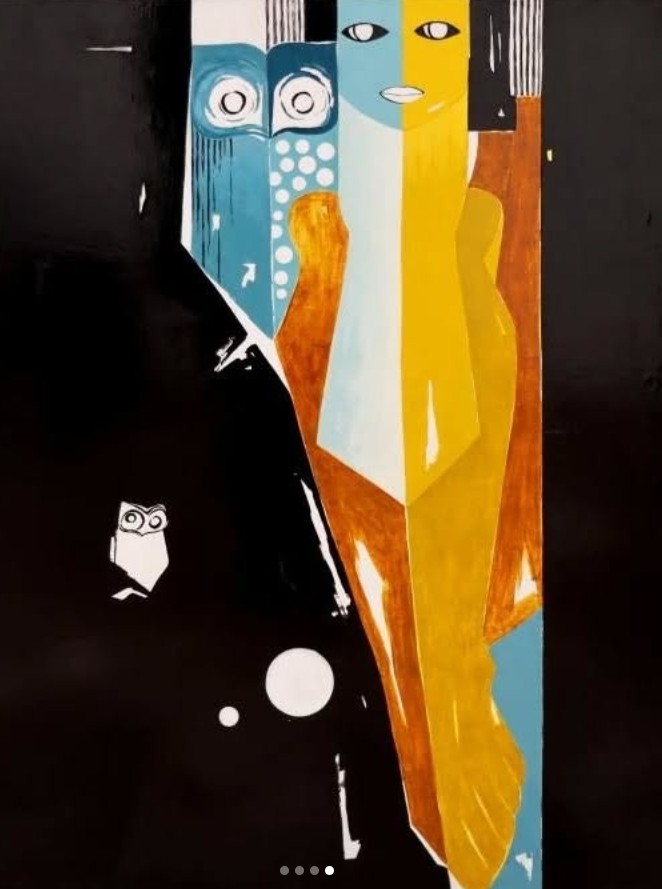
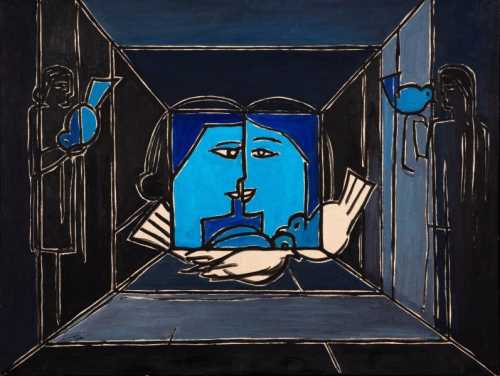
Artwork accompanying this essay is by Iranian painter, poet, and santur player Talieh Kamran







Dear Purple Saxifrage,
Your essay has touched me very deeply. I’ve come back to reread it three times, and I will come back again. I am stunned by your courage and persistence, and I hope you will write more. I am thrilled that you have found a partner who supports and loves you, and congratulations on your doctoral success! That is amazing.
I send love and kindness sailing your way. Please feel free to write me directly if you choose. I turn eighty this month, and am a very active poet.
–Amrita