My mother loved history, which was for her less about the conquests of the great men than the outfits of the ordinary people. Our home was filled with books documenting everyday costumes through the ages—the hats people had worn, the shoes, the rising and falling hemlines, the expanding hoopskirts, the drape of cloth, the textures, the colors. “What goes around comes around,” my mother always said. “The Romans were wearing bikinis, and the Minoans were going topless.” When everyone was in a tizzy about men’s long hair in the sixties, my mother kept reminding people that it was the Prussian army, precursors to the Nazis, who preferred the buzz cut. “Hair is an expression of personal identity, and fascist groups always want to homogenize appearances—this haircut, that kerchief. I say let people be whoever they want to be.” Nevertheless, she dyed her own hair for years in order to look younger. We are all susceptible to cultural pressures.
Our house was filled with old costumes my mother had created for various productions. Putting them on changed how you felt about yourself. A corset was a literal prison; an enormous hat made you feel taller, an ornate brocade robe more special. How people adorned themselves told you so much about who they were, how they thought about themselves, what mattered to them. This wasn’t history as it was written down in the official records but as it was lived in a past moment in time. A costume was a magical way of summoning that direct experience. When I was Amy March in a production of Little Women at our local community theater as a teen, all of us actors would bump into each other when waiting backstage in the darkness, our hoopskirts colliding in a recreation of the enforced distancing of the Victorian era.
So much of acting, too, is a way of transcending one limited way of being and knowing who you were. That was what I loved most about being in theatrical productions—not just becoming someone else, but knowing that someone else existed within me. During the medieval revels and ancient feast days, people often took on other identities through costumes—men became women, women men; peasants wore the crowns of kings, and kings transformed into animals. Our Halloween celebrations are a meager remnant of what was once a powerful, seasonal reminder that we are all so much more than we appear to be. The beggar at your door might be an angel; the buck you hunted might once have been your child; the grandchild in your arms might once have been your grandmother. Each of our souls has known so many different incarnations, so many different lives and bodies.
As a child, I often had the feeling, derived from so many of the fantasy novels I’d read, that in the right moment and in the right frame of mind I might be able to step from one time into another, one body into another, one reality into another. I might be able to slip through the wardrobe door at any moment to a different realm. At dusk on a summer evening at the edge of the forest, I might enter a golden glade that became an entirely different world. It felt possible to me. If I could change my clothes, could I not shapeshift my very being as well?
My mother handed me a book to read when I was about twelve about a man who time traveled in just such a manner. I had never dared confide in her about my imaginative life, my elaborate daydreams, worried that she would think there was something the matter with me, something off, something crazy. She told me she was giving me Time and Again by Jack Finney because it was a “simply marvelous historical record of New York in the nineteenth century.”
The novel was about a man who shifted his reality, not with a special spell or an elaborate machine, but simply by changing his state of mind. The premise of the book was that a top secret government organization had realized that if, as quantum mechanics posits, time is not linear but rather folded over itself like a piece of origami paper, then what keeps us inside of one experience of time rather than another is simply an elaborate matrix of cultural markers—the language we speak and think in, the sensory familiarities, the reference points like newspapers and cars and airplanes in the sky.
Remove those markers or shift them, and time itself would become something else. In any place in the world, all time is present—just as it is in a rock on the side of the mountain that shows the striations, like a ream of paper, of layers and layers of epochs.
The main character undergoes an elaborate yet relatable reprogramming of his own place in history. He moves into a building not renovated since the nineteenth century. He begins wearing different clothes made from authentic fabrics. His food and newspapers and books, all historically accurate, are delivered to him by actors in period dress as well. Will he open the door one day and step into another era? Of course he will.
What I began to wonder, even as a teenager, was how often we were slipping through the paper folds of time without even realizing it. What if in our dreams, liberated from our waking certainties, we were able to access the experiences and memories of other lives? Wasn’t this how a place could feel like two or three places at once, a person two or three different people we had known? As we emerge from sleep, we translate our adventures into the language of our current reality. The dreams we cannot hold on to, perhaps, are from lifetimes so foreign to our everyday experience that it is almost impossible to make sense of them upon awakening.
Forget outer space or the depths of the ocean: the great uncharted territory is the realm of sleep. Scientists don’t even know what dreams really do—only that if we are deprived of them our lives fall to pieces. The problem, of course, as with most modern science, is fundamentalist notions of time and space, being and consciousness. The researchers were confused to discover that even in the womb before we have ever experienced a waking life, we are already dreaming. What could we possibly be dreaming about?
One scientist, Mark Blumberg, suspects that we are “learning how to have a body.” For Blumberg this is mostly about biological mechanisms that he documents after implanting all manner of horrors into the heads of baby rats and watching how they twitch. Yet I think Blumberg is probably onto something he cannot spiritually comprehend. We are learning about the bodies we will have through the bodies we have had. We are remembering what it is like to have so many other different bodies: bodies that crawled and flew and swam, bodies that suffered and died, bodies that loved and lost and loved again, bodies whose experiences we can recover when we are asleep and can visit to reclaim what we need for these bodies we are currently inhabiting.
Or maybe we are always in many bodies simultaneously. When time is no longer linear, when it is folded over itself, then a soul, like an electron, can be in more than one place at once.
On my daily hike up the mountain near my house there is a narrow stretch of path—steep and wooded, cascading in rocks to a cleft of streams and moss to my right—that I walked in dreams long before I moved to the Catskills. In those dreams, sometimes I am simply there—fully present in this place, immersed in my thoughts, and feeling everything deeply. I know exactly where I am, but not entirely when I am. Sometimes, I think I have walked on this path in different lands and in different times. I think I will always be walking on this path.
As I step down that narrow mountain path one spring afternoon, a salamander crawls into a patch of sunlight. Tomorrow the mountain laurel will begin to bloom. In the fall, the oak leaves will cover the forest floor. The stream will turn to ice. And then it will melt and freeze again. How does the water flowing out of the spring in the mountainside, water that fell from the clouds a million eons ago, experience time? How does the stream dream?
To feel the depth and width of time all around and within us is also to know how miracles happen—outside of the linear inevitabilities of cause and effect, outside of logical rational certainties. We pray to our ancestors, and we know our ancestors are us, here now, walking this path. We pray for our descendants, and we are praying for ourselves. Magic happens in the secret folds of time and space when one place is also another place, one time another time.
From the book Mothers of Magic by Perdita Finn. Reprinted by permission of Running Press, a subsidiary of Hachette Book Group, Inc. Copyright © 2026 by Perdita Finn
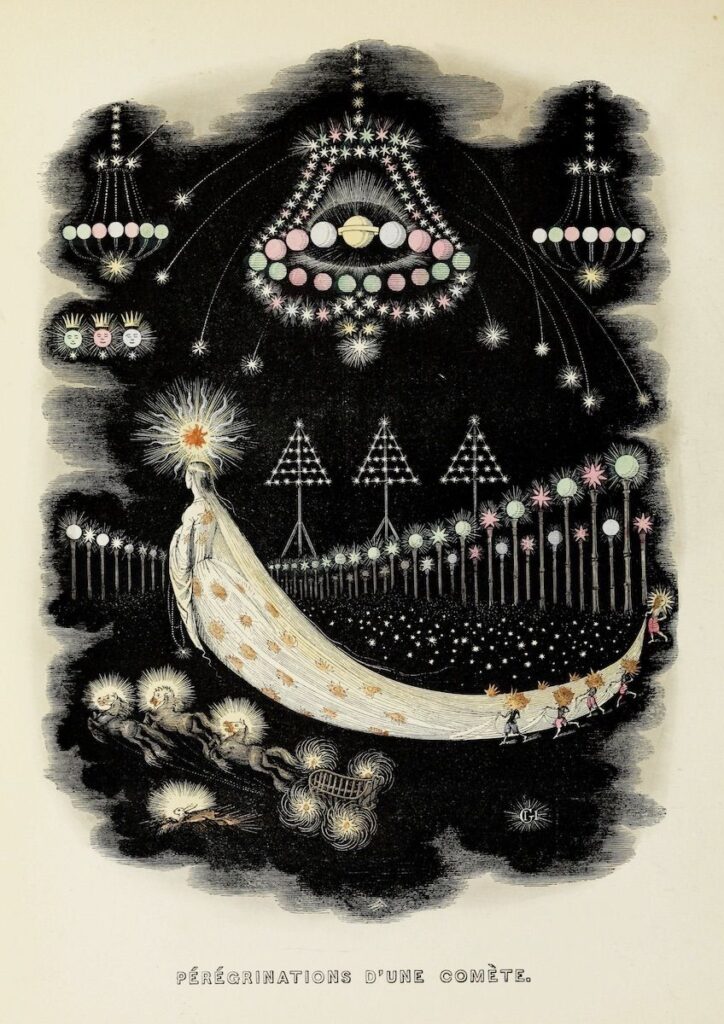
Artwork by J. J. Grandville (1803-1847)