I’ve been arguing with God for most of my life.
Not in the dramatic, shouting-at-the-sky way — more like a long, stubborn court case that never quite adjourned. I’ve talked about faith and doubt with friends over kitchen tables, with colleagues in long drives home, with pastors and priests who meant well, and with family members who carried their beliefs like inherited furniture: heavy, familiar, and rarely questioned. My views have shifted more than once. I’ve read the theologians and the skeptics. I’ve tried it on, worn it for a while, and watched it crack. I’ve studied the secular science world, hoping to find a definitive answer there. I’m still not sure I have one.
But I’ve come to believe this much: there is something larger than myself — call it God, The One Creator, the divine, the unseen order of things — and I’m connected to it. In my view we all are, whether we admit it or not. And if there’s one part of the spiritual life I am no longer confused about, it’s the role fear plays in nearly everything we call faith.
Because the first church I ever knew wasn’t love. It was fear.
I grew up adopted into a home where silence was a survival skill. “Spare the rod and spoil the child” wasn’t a proverb to my parents, it was policy. Conversations about right and wrong didn’t happen. Questions didn’t happen. You didn’t explore a thought — you obeyed a rule. My brother and I learned early that curiosity could be punished the same way disobedience was, sometimes harder.
Sunday mornings looked respectable from the outside. We wore our little suits, sat still in the pew, hands folded, eyes forward. People probably thought we were reverent children. We weren’t. We were scared children performing calm. We didn’t sit still because God was holy; we sat still because our parents were not safe when crossed. Church became less a place to meet God and more a place to rehearse how not to get hurt.
Even then, I had questions about the Bible that wouldn’t leave me alone — about stories that felt brutal, about commands that didn’t sound like mercy, about how “love” could be held up by threat. But in my house, questions were a type of danger. So I swallowed them. And when you swallow things long enough, you stop trusting your own throat.
Fear does something very specific to a child: it makes you confuse compliance with goodness. It makes you mistake stillness for devotion. It makes you think God is a supervisor and faith is a performance review. I didn’t have those words back then, but I lived their consequences for decades.
By the time my brother and I left for the military right after high school, I didn’t have a spiritual identity. I had a survival identity. I put “Baptist” on my dog tags because that was the only label I’d ever been handed — and because the military needed a box checked. But I didn’t know God. I knew fear. I knew obedience. I knew how to read authority and survive it.
THE MILITARY PERSONA AND THE QUIET HUNGER
The military was my first clean break from childhood — and my first real lesson in how a person can look strong while being hollow.
Basic training took the fear I already knew and gave it a uniform. I learned quickly how to control myself under pressure, how to shut down emotion so it didn’t show on my face, to project confidence even when my stomach was a knot. I was good at it. Good enough that I got picked as a squad leader at eighteen. The role fit me like a glove. I didn’t realize I’d been waiting for it. For the first time, authority wasn’t something I had to endure. I had it.
That does something dangerous to a young man with an old wound. Hierarchy felt like oxygen. It silenced doubt. It rewarded hardness. It let me trade the chaos of childhood for a system where clear orders could replace complicated feelings. And for a while, it worked — too well.
When I came out of the service, I carried a persona that looked like maturity but was really armor. I had a steady job, a steady exterior, and a private darkness I didn’t know how to name. The old fear had changed costumes. It wasn’t fear of punishment anymore; it was fear of being small, being unseen, being vulnerable, being proven worthless. I learned to outrun that fear by staying busy, staying sharp, staying in control of any room I entered.
The problem with control is that it feels like peace until the day you stop moving. I remember nights in those years where I’d be sitting alone after work, house quiet, television talking to itself in the background, and I’d feel this low, familiar vibration in my chest — not panic exactly, but a kind of emptiness with teeth. It wasn’t thoughts of death so much as thoughts of meaning: What am I doing all this for? Who am I when no one is watching? What happens when I can’t hold the world at arm’s length anymore? If you don’t have a spiritual center, those questions don’t sound philosophical. They sound like a threat.
So I did what I’d always done. I hardened. I worked. I built. I performed competence.
From the outside, I was advancing. Inside, I was a man trying not to feel.
Then life started interrupting me.
There were moments — quiet, ordinary moments — where something around me seemed to intervene in ways I couldn’t explain. A close call that should have gone the other way. A door opening with timing too clean to be luck. A catastrophic outcome that felt diverted by inches. I don’t mean “miracles” the way people argue about them online. I mean the kind of thing you can’t prove to anybody else, but you can’t un-know once it happens to you. Those moments didn’t come with a sermon attached. They came with a sensation: that I was not as alone in reality as I had trained myself to believe.
At first, I resisted that idea. I dismissed it as psychology, coincidence, or wishful thinking. But it kept happening — not often enough to be predictable, just often enough to be impossible to ignore. And more importantly, the effect of those moments was different from fear. Fear makes you smaller and more defensive. These moments made me quieter, less armored, more capable of tenderness without feeling weak.
That was the beginning of my investigation into spirituality — not because I wanted a religion, but because something in me finally admitted I couldn’t live on fear and performance forever.
FAITH, BELIEF, AND THE INVISIBLE THREAD
I spent years trying to define what I’d never been allowed to ask about. That’s where most people begin: with a definition.
Faith, in plain terms, is trust in something you cannot fully prove. Belief is a conviction about what is true. But the older I got, the more I realized belief and faith are not the same thing. Belief is what your mind says is real. Faith is where you place yourself in relation to what you believe — loyalty, commitment, a posture of trust.
It’s possible to believe the right things and still be hollow, and also possible to believe imperfectly and still be alive in your faith. Once I saw that, I stopped pretending faith was only intellectual agreement. Faith is relational, and relationships are always tested where evidence runs out.
WHEN RELIGION HELPS — AND WHEN IT GETS IN THE WAY
Religion is an organized set of beliefs and practices shared by a community. Spirituality is more interior: a sense that there is something greater than ourselves, a purpose, a peace, a belonging to a cosmic or divine reality. Faith is the foundation under both: the posture of trust toward that reality.
Religion can be a doorway into spirituality. It can also be a wall that blocks it.
At its best, religion gives people structure, community, ritual, a language for mourning and gratitude. It can cultivate moral imagination and habits of humility and service. But organized religion is built by humans, and humans are complicated. Institutions can become obsessed with control, status, and conformity. They can make God feel like a distant administrator who must be accessed through human gatekeepers. They can teach fear as if fear were holiness.
My childhood church did not awaken love in me. It taught stillness and outward performance. The faith never felt alive in our home. That kind of religion doesn’t form faith. It forms compliance. And compliance, when it survives long enough, often turns into either rebellion or numbness.
I chose numbness for a long time.
THE PROBLEM WITH FEAR-BASED FAITH
Fear can spark someone’s search for God, but it’s a shaky foundation for faith. Fear may get you to the doorway; it cannot carry you into the house. Fear-based religion works by threat: believe this or be punished, follow this or be excluded, doubt this or be shamed. That system can produce outward morality, but it can deform the soul.
When fear is your reason for goodness, goodness does not really belong to you. You are not kind because love has animated you; you are kind because you’re afraid of consequences. It may keep you from harm, but it doesn’t teach you how to be whole. And fear is easy for humans to weaponize. It becomes a tool for controlling others, defining enemies, and demanding allegiance that has nothing to do with God. History is full of examples of faith turned into propaganda. The deeper truth is smaller and more personal: fear makes people easier to lead away from compassion while telling themselves they’re doing God’s work.
MARRIAGE, CATHOLICISM, AND LEARNING TO LIVE WITH MYSTERY
When I married my current wife, Catholicism became not a theory but a household. She is devout. I didn’t want to shatter a lifetime dedication to a faith that had given her stability and hope. When we had our daughter, we continued as Catholics.
Here’s my honest confession: I was — and sometimes still am — a hypocrite inside the denomination. I don’t accept all its requirements. I struggle with parts of its history and with aspects of doctrine that feel too institutional to be divine. But I also find something there that my childhood church never gave me: a lived
spirituality that can breathe inside ritual. I feel more spiritual when I attend Mass. I feel less afraid, less alone, more connected to a goodness that doesn’t require me to understand everything before I can trust it. When I was younger, I thought certainty was the point of faith. Now I think faith is learning how to live responsibly with mystery.
WHERE I’VE LANDED (FOR NOW)
I don’t claim a final conclusion. I don’t think people get those. What I have is a sharpened sense of what is healthy — and what is poisonous — in the spiritual life.
If a belief system makes you more compassionate, more humble, more connected to the dignity of other people, it’s probably aimed in the right direction. If it makes you more fearful, more superior, more contemptuous, something is wrong — even if it’s wearing holy language.
Spirituality, to me, isn’t a membership card. It’s the steady recognition that we belong to something larger, more ordered, more benevolent than our panic lets us see. Faith is the trust that lets you live in that reality. Religion is a tool that can support that life — or distort it — depending on how it’s practiced, and by whom. I no longer believe God is impressed by fear. I believe fear is something God heals.
When I look back on my childhood, I don’t feel hatred toward the Baptist church itself. I feel grief for a version of faith filtered through violence and silence until it couldn’t nourish anyone. When I look at my life now, I’m grateful the story didn’t stop there.
If faith is real, it should make us braver — not reckless, not loud, but brave in the quiet places where we face loss and guilt and emptiness without needing terror to prop us up. I spent a lifetime thinking faith was about being right. I think now it’s about being faithful to love, even when love can’t be proved like a math problem.
Maybe that’s the best definition I can offer: faith is what remains when fear no longer gets to decide who God is.
And if I’ve learned anything worth passing on, it’s this: the opposite of faith isn’t doubt. The opposite of faith is fear dressed up as certainty. Real faith makes room for questions and still chooses mercy. It does not need threats to stay standing.
I don’t know everything about the One Creator. I’m not sure anyone does. But I know what fear did to me, and I know what faith has begun to undo. That’s enough to keep walking toward the mystery — not as a child performing calm in a pew, but as a man finally willing to trust that love is not a trap.
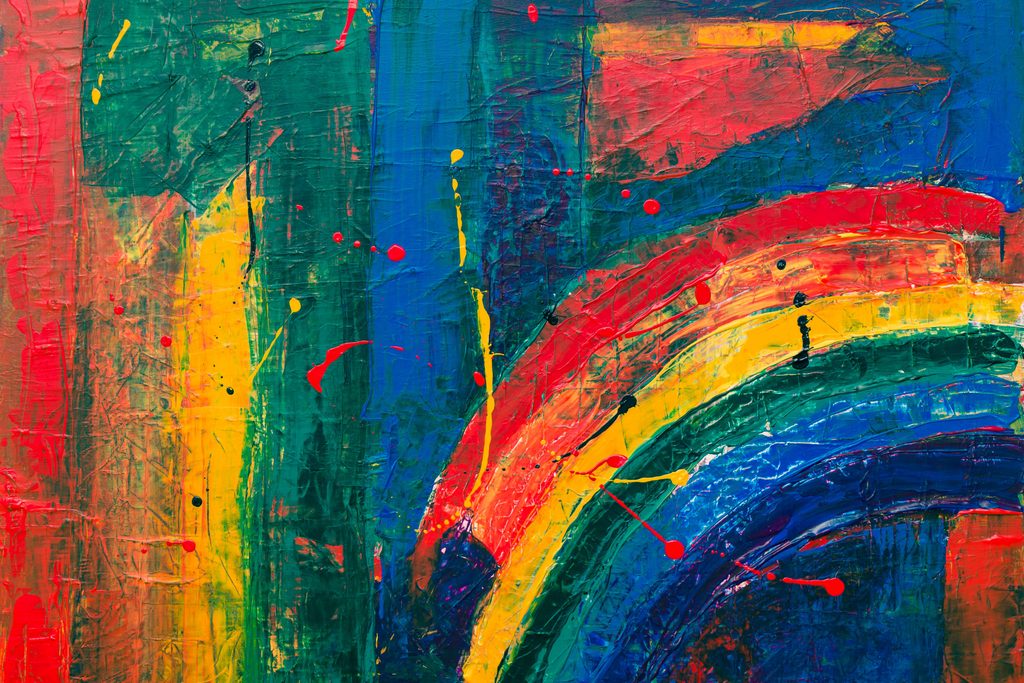
All paintings by Steve A Johnson.

Your ideas are so beautifully written and I resonate with every single one of them. I agree with you that fear is the enemy. And out of that fear comes dogma. Thank you so much for sharing this. I’m going to save it and read it when I need to be reminded.