The people of the Native American Crow Tribe have a myth about a woman’s ability to perform a seemingly impossible task. According to legend, a husband demanded that his wife tan a buffalo hide and embroider it with quills in a single day to make a blanket for him. The woman took the buffalo skin to the woods, laid it out, and began to cry because she knew that she could not complete the task in so short a time. Tanning a hide alone takes days or even weeks. A badger came to her and asked why she was crying. Through her tears, she explained the insurmountable challenge. The badger assured her that it could be easily done and ran off to get assistance. She returned with three more female badgers and with four female beavers. These eight spread out the hide and staked it tight. Then female rats, moles, and mice came, along with female ants, bees, and flies. The flies took the flesh from the hide, the bees dried it before the sun was very high, the ants scraped it, and the mice bit off the rough parts to make it smooth. Then the animals removed the stakes and a skunk worked the hide along with the beavers and badgers until it was soft. A porcupine took out its quills and the ants helped the woman with the embroidery until it was decorated with stripes of quill work. When it was finished, the animals rolled up the blanket and sent the woman home with it along with a warning that her husband meant to kill her. They had already devised a plan to prevent her death and gave her detailed instructions on how to survive—a truly lifesaving team of female helpers.
This tale is a beautiful portrayal of the necessity and rewards of female solidarity. It also highlights the cooperation among Native American women of the Great Plains when faced with a challenging artistic task. The tanning and dressing of hides and their ornamentation with quillwork and beadwork were undertaken as a sacred endeavor within the realm of women’s artistic societies. It was a way for women to work together, support each other, and carry on cultural traditions.
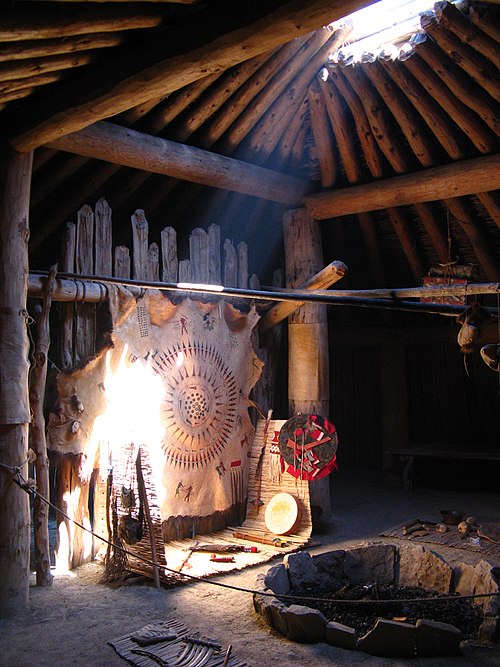
Textile production created opportunities for women to make new connections, collaborate, and bond over their work. Historically, the sexual division of labor was not a source of isolation, as it later became under capitalism, where the family unit is central. Rather, it brought women together in communal labor. In patriarchal societies that seek to divide women and often remove women from their families of origin through marriage, joining forces gave women a sense of solidarity and a greater voice in their communities. Cooperation in textile production has long been a source of power and protection for women.
In Women’s Work, archaeologist and textile scholar Elizabeth Wayland Barber describes the “courtyard and outrider” economy of the Neolithic and Early Bronze ages of at least four thousand years ago, where women gathered in the communal courtyard area to work on craft projects—spinning, weaving, pottery—while the children played. Producing textiles became central to socialization, particularly in the winter months when there was little else to do. Barber notes that Neolithic textiles are remarkably ornate—multiple colors are used to weave patterns, and beads and embroidery are used to adorn the cloth. She surmises that the fun that was had spinning and weaving together may help explain the tendency to embellish fabric and make things that were not purely utilitarian.4 The extra time spent making something beautiful allowed extra time to be with friends—learning from each other, inspiring each other, and joining their efforts and materials.
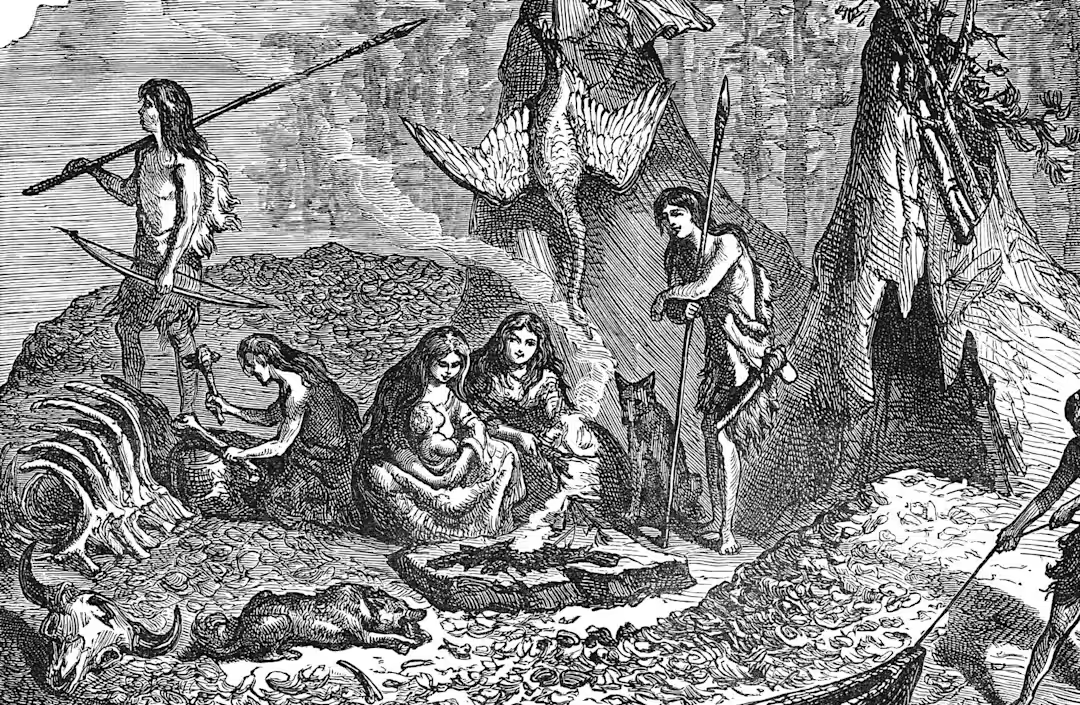
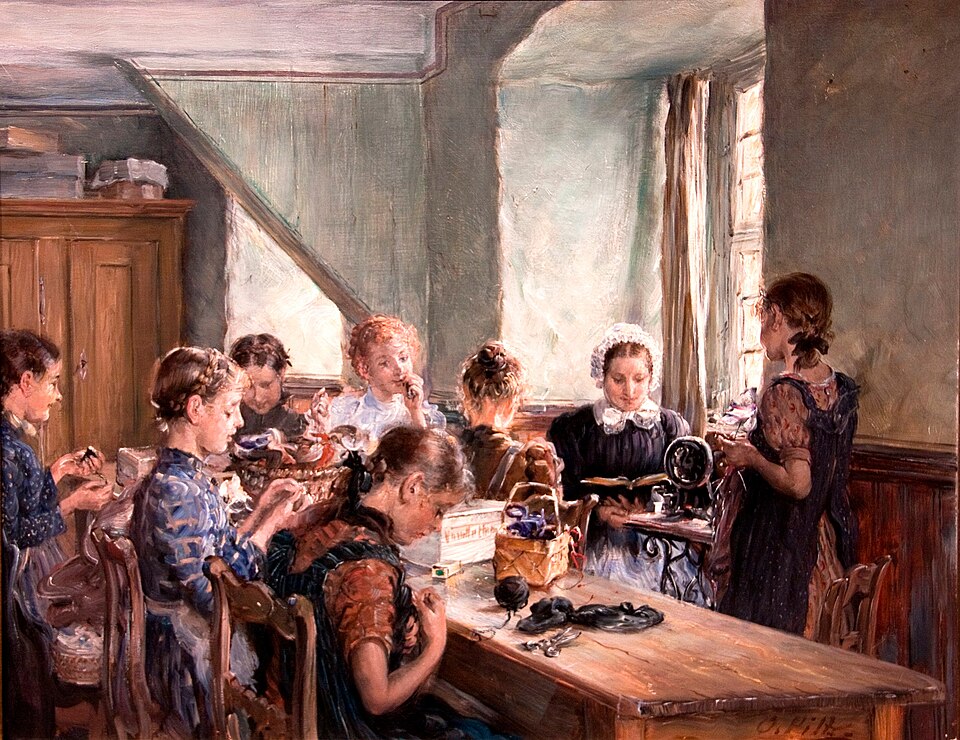
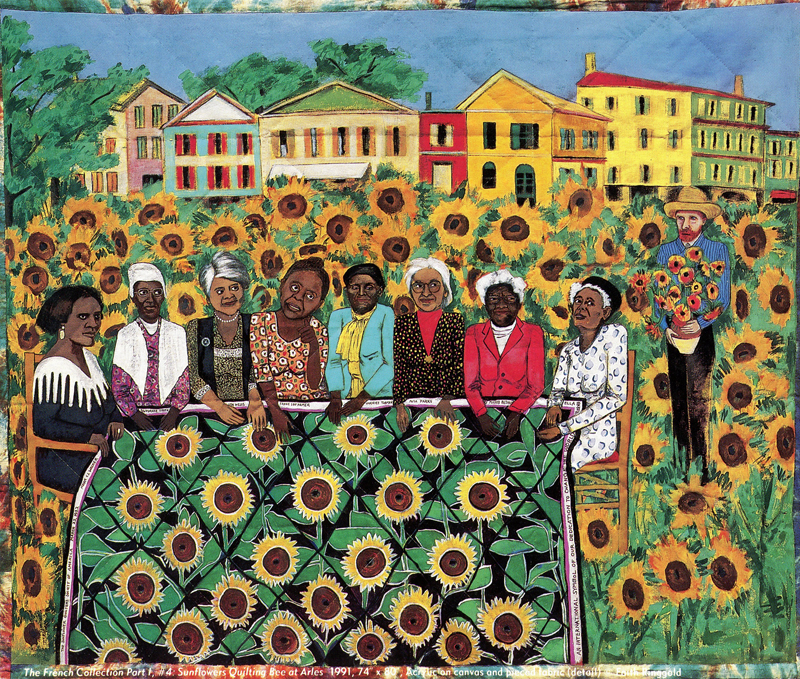
In more recent times, women in northern Europe from at least the eighteenth century on gathered for “spinning bees,” communal events that allowed women to keep each other company and share materials while they spun yarn. During the dark days of winter, spinning bees also allowed women to share the light and warmth of a fire rather than expending those resources individually to work in their own homes. Quilts were often made in collaboration, with a number of women making blocks that were then sewn together. Quilting bees allowed women to complete the tedious work of stitching the layers together. Because of the communal effort, it was important that every woman who stitched on a quilt was an expert with the needle, so that no one was disappointed that the quilt they had spent months or years piecing was spoiled by poor top stitching. Poorly developed sewing skills meant being left out of important social gatherings.
In Shetland, the communal aspect of textile work is an important part of the culture, with women knitting together at social functions. Fair Isle knitter Hazel Tindall recalls her mother saying “tuck your sock,” which meant take your knitting, when they would go to a party and the women would knit the whole night. Creating cloth provided a social outlet and shaped the time women spent together while working toward an economically beneficial craft.
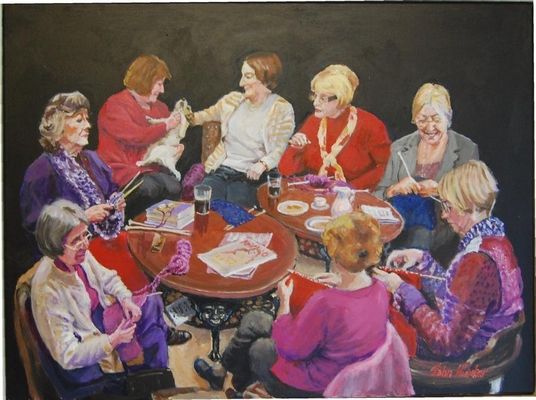
A study of over three thousand knitters found that knitting in a group significantly impacted their perceived happiness and improved social contact and communication with others. Making things together, whether collaboratively or just in the company of others, eases social interaction. When the brain is occupied with a background task, conversations become easier, deeper, and more intimate because people are less self-conscious. A shared interest creates a sense of immediate belonging and provides a natural topic of conversation. Knitting groups can help develop people’s social skills and increase their confidence, which can then lead to improved interpersonal interactions outside of knitting circles. Writer and knitter Ann Hood learned a lot from her experiences in knitting groups:
By now I have gone to many, many knitting circles. And I realize that because of them, I actually do better in all kinds of groups. I have learned to listen, even to the person who can’t stop talking about her knitting, her vacation, her husband. I have learned to respect people who are really different from me: younger or older; politically; socioeconomically; in every possible way. . . . And I have learned that I don’t always have something to say, or something to add to a group. That sometimes, I just want the company of other people. I just want to sit in a circle and knit. By doing this, maybe I am learning how to be a group person after all.
When you’re making something in a group, it is perfectly acceptable to work quietly if you feel shy or are not in the mood to make conversation. Psychoanalyst Jessica Benjamin writes that the ability to disengage is a necessary condition of freely engaging and is the basis of mutuality in relationships. Without another activity to focus on, people often feel compelled to keep a conversation going, which may make the interaction feel forced or keep people from beginning a conversation at all. Many people who attend knitting groups tend to work on simpler or more tedious aspects of projects so they can devote more mental energy to conversing and because the rote aspects of textile work are made more enjoyable by the company of others. In fact, knitting group members cite attending group more for the sense of belonging and social interaction than for the knitting process or technical support.
Collaboration in the creation of textiles enables conversations between women that, like quilts, end up as something greater than the sum of their parts. William S. Burroughs and Brion Gysin, prominent artists of the Beat Generation, wrote about the concept of a “third mind” that represents the added possibility that arises when two minds come together—the “unseen collaborator” that exists only in the meeting of two minds in creative collaboration: “Two subjectivities that metamorphose into a third; it is from this collusion that a new author emerges, an absent third person, invisible and beyond grasp.”
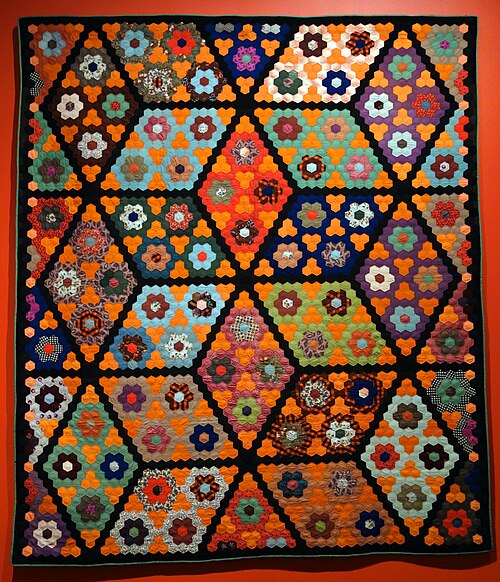
Likewise, a quilt created by many hands sharing resources is beyond what any individual could create alone. The act of quilting in a group allows women to share their stories and their fabric pieces, transforming both. What emerges is not only a quilt but a memorable experience. A quilt is also in dialogue with the viewer—another sort of third mind—who creates their own meaning from the object.
Burroughs and Gysin collaborated using what they called “the cut-up technique,” which involved taking existing pieces of text, cutting up the pages, and rearranging the pieces to form new narratives. They explain, “The cut-up method brings to writers the collage, which has been used by painters for fifty years. And used by the moving and still camera.”
The authors mention nothing of quilts, which of course preceded cameras and the collage method in modern visual arts, for which Picasso and Braque tend to be given credit. Yet quilts are undoubtedly a form of this “cut-up” method, and the narratives created by them similarly depend on the arrangement of the pieces. In 1977, Canadian multimedia artist Miriam Schapiro and American painter Melissa Meyer coined the term “femmage” to describe women’s long-standing practice of saving and assembling the scraps of daily life in unique and interesting ways, such as in quilting, scrapbooking, paper cutting, and beading—transforming collected materials into something decorative and functional. They stressed its importance as a predominantly female artistic expression that created a “secret language” among women through the symbolism of the materials and their juxtaposition.
This essay was excerpted from With Her Own Hands: Women Weaving Their Stories. Copyright (c) 2025 by Nicole Nehrig. Used with permission of the publisher, W. W. Norton & Company, Inc. All rights reserved.