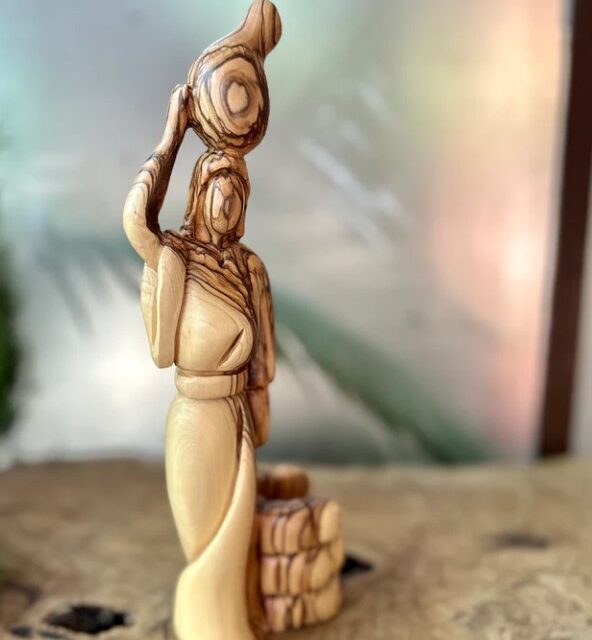
It was the Woman at the Well’s sinewy beauty that caught my eye first. Hand-carved by artisans in Palestine, the olive wood sculpture of the storied figure accompanied oils and spices and remarkable traditional embroidery from the battered motherland. At the Tucson benefit for Artisans Beyond Borders, we would learn more about traditional “Tatreez” embroidery, and I would discover mysterious universal connections in the embroidered symbols, in particular what I now call the Mother’s Star, a wonderfully transgressive symbol that migrates silently across borders and cultures, time, and space.
The Woman at the Well, herself a symbol of the borderlands, came home with me that day and took her place on my altar among my old family bibles. First thing every morning, I see her, a robed figure balancing a water jug on her shoulder, and then I see her again, in my news feed – robed women carrying whatever sustains them and their families, carefully stepping over shattered concrete in the once thriving community of Gaza.
The story of the Woman at the Well takes place between 26 and 36 AD, in Samaria, now a contested territory in the West Bank. As a Samaritan with differing beliefs from the prevailing Jewish religion, and as an ‘unbound’ woman not living in wedlock, she is an outcast. She walks alone to the well, encounters Jesus there, and experiences a profound sense of unconditional love. She rushes to tell the townsfolk in what many Christians consider the first ministry. Like the Woman at the Well led her people to Jesus, she leads me now on a pilgrimage through history and culture to uncover the meaning of the mystical Mother’s Star.
For women of that time, embroidery was the language used to convey their marital and social status, ancestry, and region, as well as to bring good luck and protection. The origins of Tatreez embroidery can be traced back 3,000 years, to the Canaanite period, even before the time of Christ. The alphabet of ancient Tatreez cross-stitch is written in symbols, patterns, and colors. What symbols, what colors would the Samaritan Woman at the well and other women of her village have chosen to mark their encounter with the man from Galilee?
Stitched symbols and motifs found on textiles in antiquity carry humanity’s living water of myth and memory, message and story, the lived experience of its maker and the maker before her, her mother and her mother before her. This is especially true for displaced families trying to root in the shifting sands of contested borders, violence, poverty, and the threat of cultural erasure.
At the benefit, the speaker who shared with us what she knew about Palestinian embroidery came robed in a traditional dress, a richly embroidered thobe. As she spoke, she passed around cloth samples. She pointed out cross-stitched borderlines that symbolized the importance of trade with other countries, along with symbols that represented ocean waves and fishnets, essential motifs for many Palestinians who make their living from the sea.
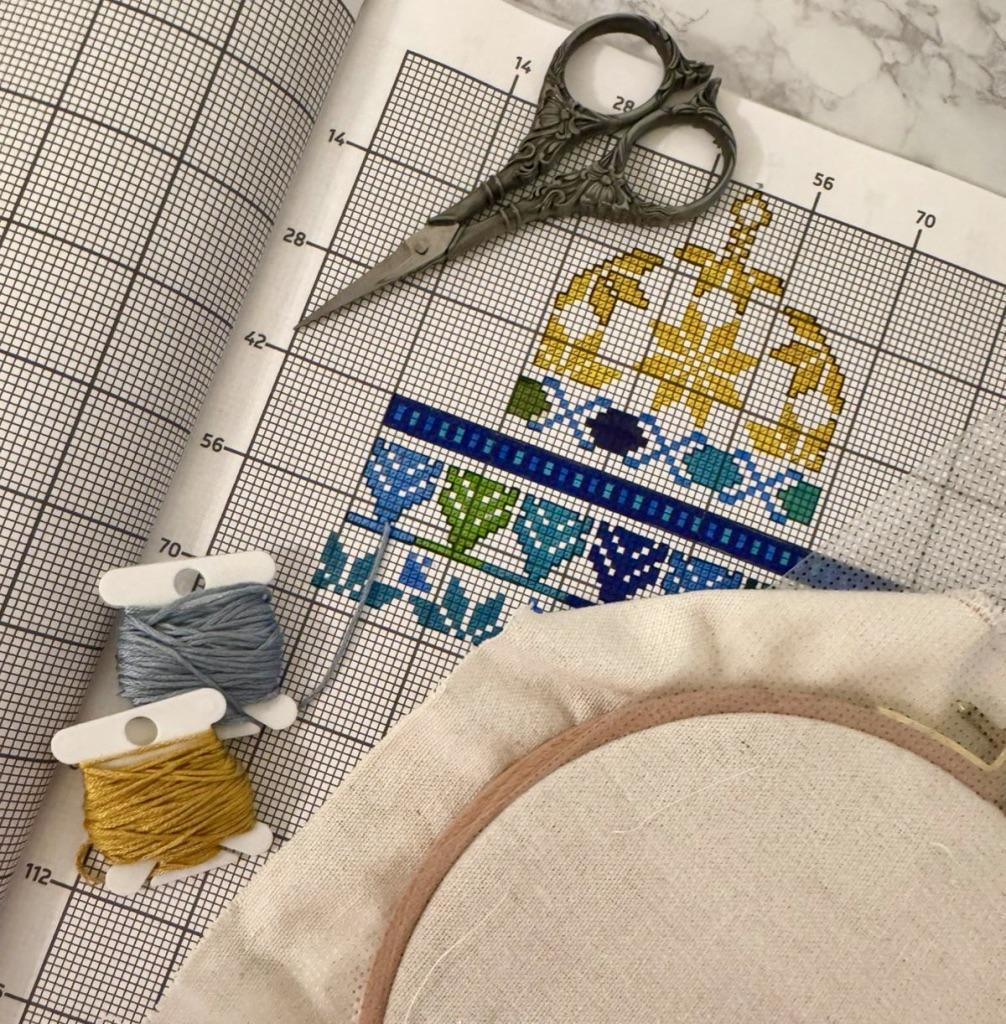
Tatreez Pattern
We learned of a modern archive of historical Palestinian symbols on the internet. I recognized many of what I think of as “ancestor” symbols —- archetypal motifs such as the Universal Tree of Life (signified by Cypress trees, palms, and pine trees), doves of peace, and sheaves of wheat. Hundreds of symbols stitched in recurrent patterns in Palestinian embroidery express fundamental human knowledge and values. The pictorial symbols are a language of the soul, a mother tongue in humanity’s inheritance.
When I saw the Tatreez symbol of the eight-pointed star in its many forms: Najma/Star (or) Qamar/Moon (or) Qamar Al Nijma/Moon of the Star, I had an immediate shock of recognition. I had seen this symbol before, in Mexico. The distinctive star was a personal and cultural lifeline for Maria, an indigenous embroiderer and a refugee running for her life.
Maria and her daughters had escaped torture in Southern Mexico, migrated north on foot, and ended up in Tucson, where a local church housed the family in a Sanctuary until sponsors for the family could be found. Volunteers from Artisans Beyond Borders provided embroidery and sewing supplies to help the artisans pass the time and potentially sell what they made. Maria’s story is not mine to tell, but she has permitted me to share what her embroidery means to her.
Her captors in Southern Mexico threw discarded clothing into the shack that she was imprisoned in to cover herself and her children, born in captivity. At some point, she found or fashioned a needle and began hand-sewing and embroidering clothes for the children.
When she finally escaped her captors, she stuffed years of finished embroidery into her backpack and carried it, migrating all the way from Oaxaca. Her embroidery was her trousseau, her heritage, the family’s everything in the world.
Like most indigenous artisans, she first learned from her mother. Maria’s mother made and embroidered all the clothes for everyone in the family from scratch, not for sale. The incredibly intricate, fine needlework could take weeks to complete. The eight-pointed star was the symbol that Maria’s mother chose to teach her daughter how to embroider. She would stitch half of the star, and Maria would embroider its mirror image. Sadly, her mother was taken from her too soon, so Maria would never know what the eight-pointed star meant to her people; all she knew was that she would always embroider it. What we do know is that the estrella star shape found in Zapotec weavings from the same area in Mexico depicts the spiritual connection between heaven and earth. It is a map to navigate life’s journey.
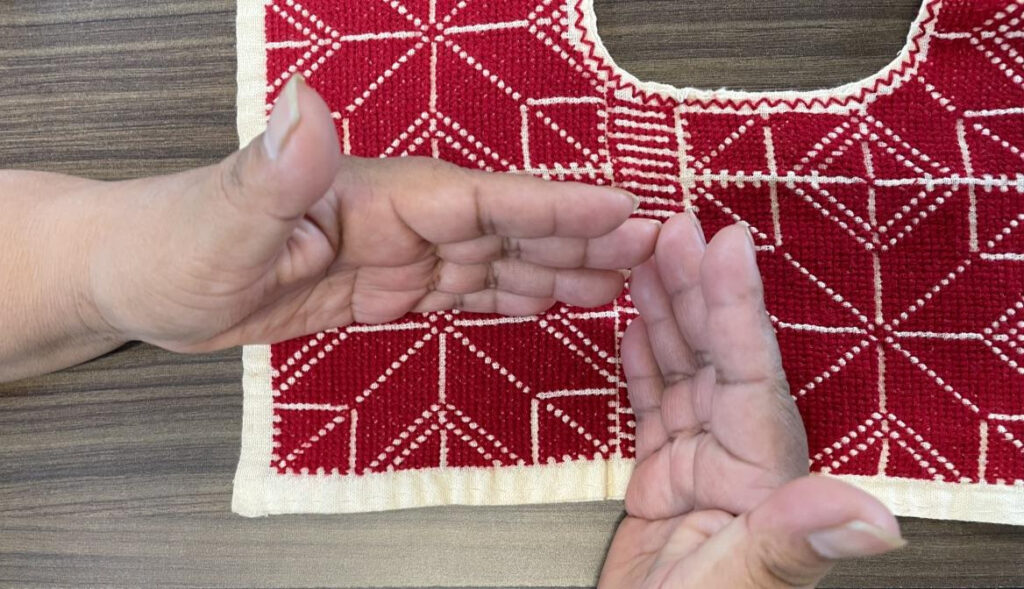
Maria shows us how she first learned to embroider la estrella
On the day I visited, Maria carefully embroidered orange flowers onto traditional Mexican cotton cloth while we talked. On a donated sewing machine, she would transform the embroidered cloth into a traditional huipil Mexican blouse. I asked Maria how she felt now, working on her embroidery here in the U.S.
“Me siento tranquila. No pienso que cosas malo.” she said, her hands expertly moving the needle in and through the cloth. “I feel tranquil. I don’t think bad things, and I am not doing bad things like what people have done to me.” Maria said. “Embroidering gives me strength, and it helps me be good with the children so that we can have a future.” She looked up from her work and slowly pointed to the ceiling.
“When I embroider, hablo con Dios – I talk to God,” she whispered.
Rarely have I witnessed such direct intimacy with the divine. Each stitch for Maria was a prayer. The star’s sacred geometry was herbordado devocional. Without her family’s beloved symbols and the craft to express the inexpressible by hand, the cultural bereavement that haunts forced migration could overwhelm her. Traditional symbols that Maria stitches into the cloth heal and protect her and strengthen her resilience going forward.

Embroidering traditional huipil collars
In the Judeo-Christian tradition, the eight-pointed star symbol, known as the Star of Bethlehem, guided the wise men to Jerusalem over 2000 years ago for the birth of Jesus. It signifies beginnings, salvation, and resurrection. In Buddhism, the symbol represents the noble Eightfold Path, which fosters right living, meditation, and wisdom. In the Islamic tradition, the eight-pointed star, also known as the Rub el Hizb, symbolizes unity, harmony, and stability.
Like the craft of embroidery, the symbol originated long before the birth of Jesus. “The eight-pointed star, found in artifacts from Mesopotamia, signified a meeting between the moon and Astarte, the Canaanite goddess of fertility,” notes Iman Saca, author of “Embroidering Identities, A Century of Palestinian Clothing.” The star’s origins also illuminate the feminine principle associated with the Hindu Goddess Lakshmi’s lotus flower that blossoms with fertility and prosperity.
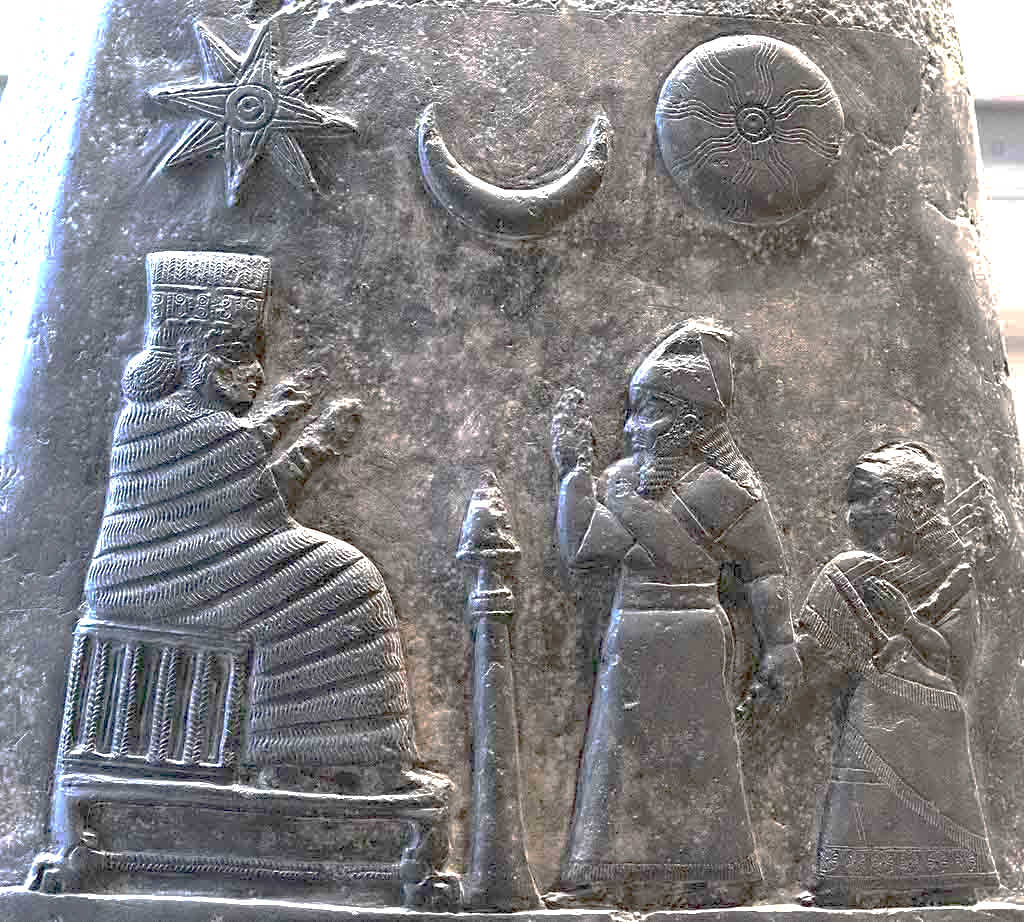
The Star of Ishtar, Mesopotamia (image source: Jastrow via Wikipedia)
***
I recently met a new friend, Dalia, a 29-year-old artist, writer, and civil engineer from Jordan, currently in Tucson on a spousal visa. Over coffee, she shares her story. Half-Palestinian on her Father’s side, she has recently taken up the craft.
“Embroidery is a way to stay close to my Palestinian/Jordanian culture, Dalia said.” We grew up appreciating our heritage, like Palestinian embroidery… like the olives on the tree… and our spices. Our culture is all around us, in school, at home, in the air.”
In the series “Embroidery Techniques Around the World,” the Embroider’s Guild of America notes, “Tatreez became especially important after the mass displacement of Palestinians during the 1948 Arab-Israeli war known as the Nakba, when women stitched and wore thobes as a symbol of resistance and resilience.” One example of hands-on resistance is the missile stitch, embroidered on clothing, an early practice that emerged between 1920 and 1948, during the British occupation.
“The (missile stitch) motif…conveys the magnitude of tragedy that occupation and violence have imposed upon the Palestinian people for almost a century,” writes Wafa Ghnaim, author of Tatreez and Tea; Embroidery and Storytelling in the Palestinian Diaspora.
“Little did Palestinian women know at the time… that it would reflect their reality for the next hundred years.”
“…It was very dangerous to speak out,” writes Feryal Abbasi-Ghnaim, award-winning master embroiderer and Wafa’s mother. “Women began to speak in silence through their embroidery.”
In Ukraine’s conflict zones, particularly along the borders with Russia, preservation of the traditional folk art has become a badge of honor and an active resistance to the Russian occupation. Dating back to the 5th century in the region, embroidery remains one of Ukraine’s most treasured cultural assets. Each area of the country has historically maintained its own unique symbolic motifs, patterns, and needlework techniques.
In a 2023 article in Al Jazeera, writer Pearly Jacob interviews Marina Romashko, an embroiderer who fled from a barrage of missiles in the central Ukrainian city of Dnipro. Before leaving her apartment, the 38-year-old Romashko hastily shoved vyshyvankas, traditional Ukrainian embroidered shirts, into her backpack, including one hand-stitched by a favourite aunt.
“I just felt I had to take something that somehow shows my Ukrainian identity and reminds me of home,” said Marina, one of eight million refugees who’ve fled the country.
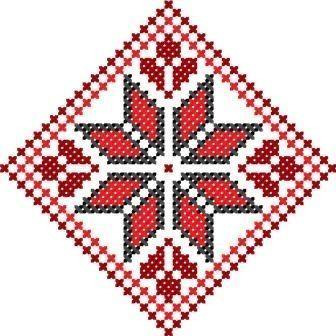
Ukrainian “Mallow”
Like the indigenous embroidery of Palestine and Mexico, Ukrainian stitching is not just decorative. It is heritage. The Ukrainian mallow, the eight-pointed star, is one of the most popular symbols in Ukrainian embroidery. Known as “The Mother’s Star,” it is found in Orthodox Icons of the Virgin Mary. Commonly stitched in red and black, the Mother’s Star signifies the union of masculine and feminine to create life, in direct opposition to the forces of war and destruction. Star motifs in general in Ukraine are considered amulets against evil, negativity, and powerlessness. To embroider the Mother’s Star is to defy the dark power of empire.
A prime example of cultural adaptation and resistance is the Star quilts made by indigenous tribes in both the U.S. and Canada. The symbol of the eight-pointed star, once found painted on buffalo hides, migrated to cloth blankets when the buffalo were eliminated on the open plains in the late 1800s and early 1900s, and Native women took up quilting in Mission schools. For the Lakota, the “Morning Star” represents the highest knowledge, hope, and guidance. Star Quilts, often given away in ceremony, hold great honor for both the makers and the receivers.
I began to wonder about the designs on my Grandmother’s quilts. Could I find a morning star on the quilts they bequeathed me? My Grandmother, Alice, and her sister, Alma, were Appalachian, from the Alleghany Mountains in West Virginia. The quilts the sisters made together in their lifetimes, like the Lakota Star quilts, were their most prized possessions to give.
As soon as I pulled the quilts down from the highest shelf in my closet, there it was: a starburst as big as me, each of its rays cut from remnants of their old cloth, appliqued and hand-sewn (pieced). What did the star mean to the sisters, the matriarchs of my family, and how had I forgotten?
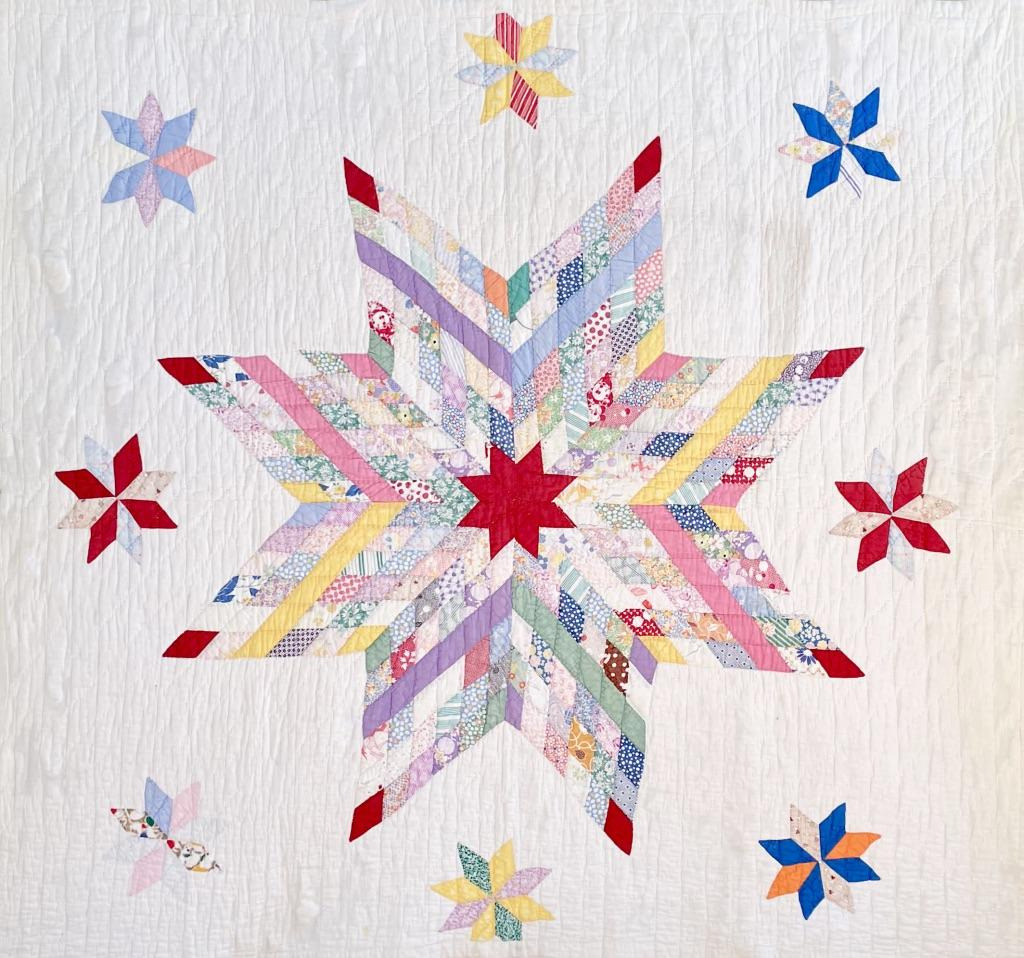
Alice and Alma’s Star quilt
The majority of Appalachians were migrants, primarily Scots-Irish and Pennsylvania Dutch families, who sought religious freedom and farmland. The eight-pointed star is a common symbol on quilts from the area and carries both spiritual and cultural significance. Folklore has it that the also named “North Star” quilt pattern may have served as a coded symbol in the underground railroad, pointing the way North to freedom for enslaved people.
Other eight-pointed stars, known as “Barn Stars,” are still visible on the sides of barns from Pennsylvania to the Southern Appalachians, connecting the people of the region to faith, the heavens, good luck, and protection from evil. Appalachians like my ancestors were deeply devoted to their faith.
In pre-Christian Celtic mythology, the octagonal star represented the Wheel of the Year, encompassing the cycle of the seasons, the balance of the four elements, and the four cardinal directions (north, south, east, and west).
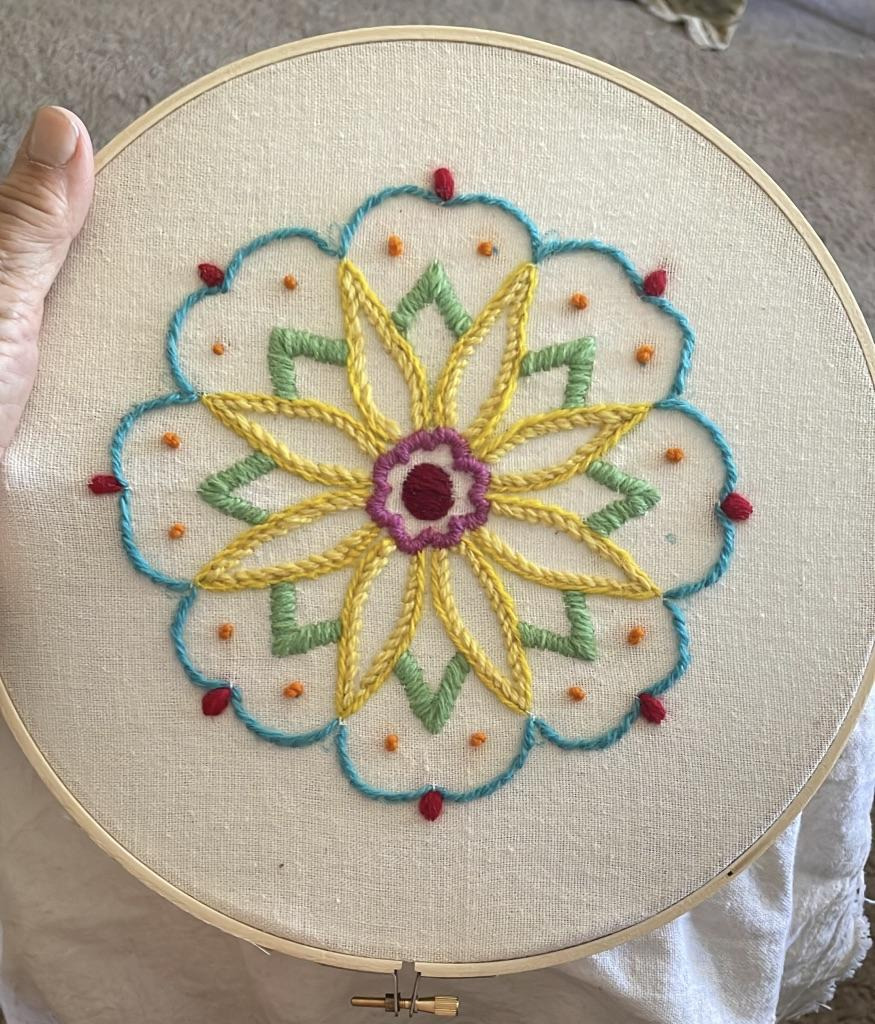
How could I have forgotten the starfield emblazoned on the quilts that covered my body as a child? A part of me must have always known. For years, as part of my own spiritual practice, I have intuitively embroidered mandalas, never questioning the significance of the eight-pointed lotus flower form at the center of each one. What I know is how it feels in my body to stitch this symbol that centers and calms my breath, and as Visio Divina, pleases my soul every time I gaze into it.
Traditional healing practices or energy medicine employ the star in ways we have yet to fully understand or empirically quantify. Ultimately, the star remains a mystery, and I, for one, am grateful that such mysteries still exist. Richly layered symbols – pictographs – predate the written word and have much to teach us beyond logic and language. Symbolic processes like Tatreez, like Mexican Bordado, and ancestral quilting point the way to our innate divinity. Decoding symbols like the Mother’s Star reveals the Holy. Culture bearers, the indigenous, artisans, and faithmakers are keeping our collective sacred wisdom alive.
I see now that, like the eight directional spokes on a compass, the star is leading me home to my people, to their God, and to my Holy Spirit. This may be part of this symbol’s purpose: to remind us, regardless of our culture, of a more receptive and feminine ethos — a unified field of balance and peace that gives us hope. Unlike other more obvious visual symbols that represent nationalistic and religious concerns, the unheralded Mother’s Star has existed all along in the background, across the globe, waiting for humanity to recognize her place in all things.
***
Dalia shows me her embroidery, inspired by the historic Dome of the Rock, the sacred Islamic shrine located on the Temple Mount in the heart of Jerusalem. In Dalia’s embroidery design, the eight-pointed star centers us in the Dome, beckoning us into the shrine’s blend of Byzantine, Persian, and Islamic tile mosaics.
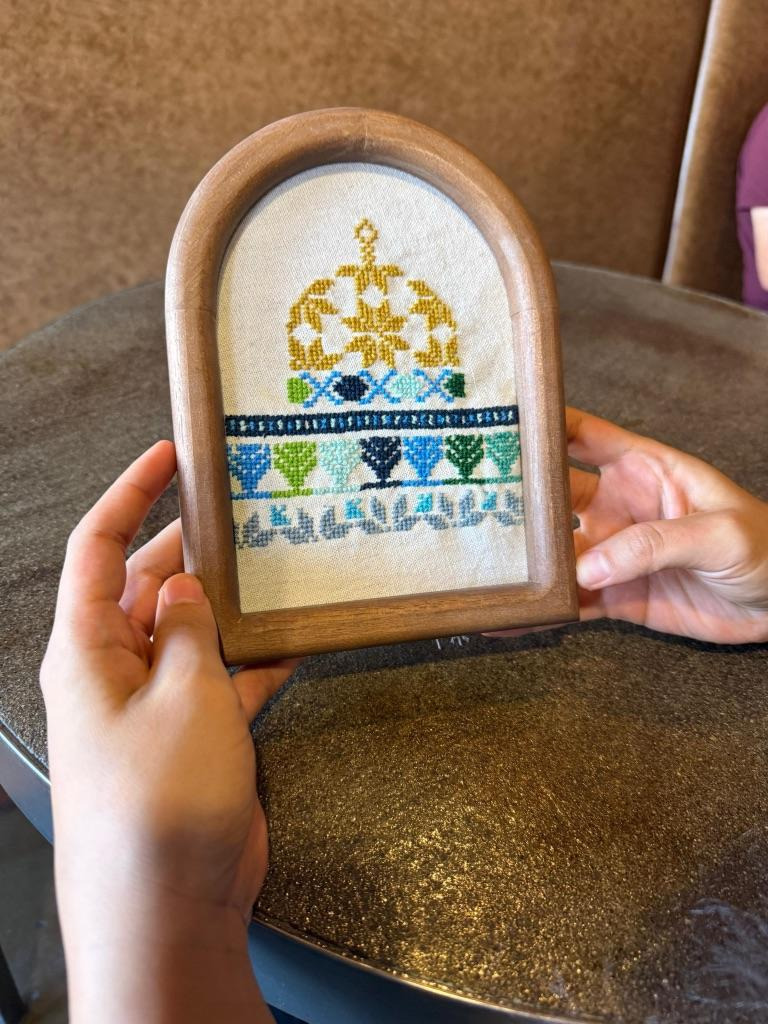
Dalia’s Tatreez
“In the middle of all the images coming out of Palestine, which are so troubling to our hearts, the embroidery helps us to keep present, to keep the thread of culture,” she says.
“It’s timeless. It’s in the present, but it’s also in the past, and through these symbols, this process carries us forward into the future.”
###
References
The Embroider’s Guild of America
Center for Russian, East European, & Eurasian Studies at the University of Kansas
Beyer, Catherine. “What You Should Know About Octagrams: 8-Pointed Stars.”.
The Ukrainians using embroidery to stand up to Russia
Tatreez, Tea, Embroidery, and Storytelling in the Palestinian Diaspora



Beautiful article. Thank you.