

As she talked, Ammachi watched the candle burn out. She pulled the scarf over her head
and suggested that I go and bring her the Bible and hymnal. She had to do her evening
devotions. This was a cast-iron ritual among all the Syrian Christian families. Everyone,
including the servants was present for these prayers. I looked at these times with a half-dread, as
I found them tedious. The hour was already late. Dinner was had, stomachs full, stories told, the
household had shut down and the air had turned languorous. Why prolong the evening? No one
except for the infants was allowed to skip this ritual.
My local cousins knew that we would all have to get through these long, lugubrious
hymns, scripture readings and prayers in sequence. Emily and Titi knew the routine so well that
at some point as Ammachi carried on with her stories, they expedited the night by going to fetch
the Bible and the hymnals and start leafing through them in preparation.
I can still see Ammachi peering by the candlelight, trying to read the scriptures while her
headscarf and hair got in the way of the fine print on the page. She would adjust her glasses and
get to it. When electricity arrived, she would be seated right under the light bulb.
When she entered into prayer, Ammachi was transfigured. The cadence of the prayer was
a slow swelling towards a crescendo. I was beginning to see her start to encircle God and get
closer and closer, just the way she had caught the rooster earlier in the day. From her tone I
sensed that she was meeting God in the pitch dark. Her language implied that God was both her
Master and personal consort. Ammachi clearly felt and saw this invisible presence in her
immediate spheres. And it was understood that if we listened and sought intently, we too would
come to see and feel her God.
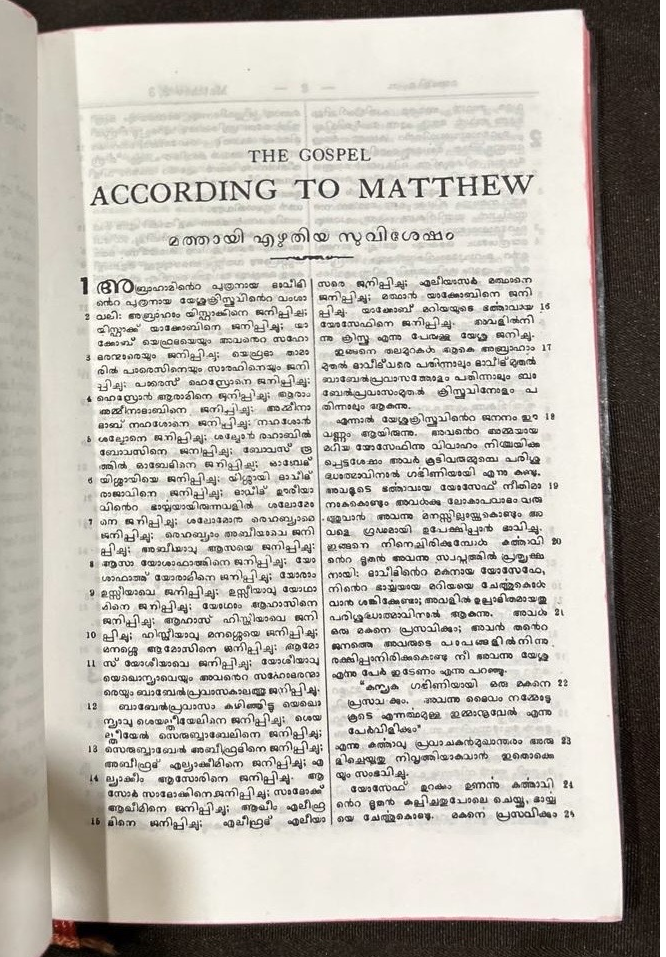
As she prayed, Ammachi adopted an exceptional and uniform tone. In an ecstatic and
ascending voice, Ammachi started with praise and gratitude from the grand to the granular in her
life: for God’s mighty omnipotence, for the blessings of our ancestors who had succumbed to
life’s ills, the monsoons that broke, the well that filled, the fish they bought, the cow that birthed,
the chickens hatched, the letter that came from the son overseas, the long-awaited foreign
remittance, and much else.
As a little girl, I sat cross-legged on the floor until my feet started to cramp. I was fidgety
and tired. With her voice quivering Ammachi descended from gratitude to supplications: asking
God for pity and mercy on our mortal curls of clay. She wept, intermittently wiping her tears.
She named the dead relatives and presented their souls for absolution. As I listened, I recalled
some of the names. They were close family members buried in the Puliyoor or Pallipad
graveyards. These pleas were followed by her moans for the good health of the living family
members, including my parents. Then she petitioned for success in school exams, the pending
job interview, the marriage proposal, the dowry, the return of her sons from Calcutta and
Malaysia, the healing of my grazed knee from an earlier fall from the tree, the child bitten by the
dog next door, and on it went. By then I felt Ammachi tussling with God. God was in her grip,
and she would not let go. She was heaving. My cousin Biju nodded off, and Titi next to him
elbowed him to stay alert. Nishi sat next to me, squeezing my hands as we tried to repress our
giggles.
There was an incomprehensible intimacy between Ammachi and her God. She was
persuading God, all the while challenging God to God’s own goodness towards creatures here on
earth. I detected much of this only with bits and pieces of the language I grasped. Afterwards, I
heard sniffles and Ammachi wiped her face dry and returned.
“Sshh, listen! Listen to the hoot, that’s the nyara!” Nishi whispered. My grandmother
heard the little black bird and sat up. “My God it’s crying!” She and my aunt and cousins were
seasoned listeners.
As I got familiar with Ammachi’s prayers over the years, I realized that the language
transcended my limitations with Malayalam. She was, in her way, giving me a fresh appreciation
of her interpretation of the minnu around her neck. She shattered the conventional meaning and
told me that far from a conjugal pendant, the minnu was about the Cross that lay on the grain. As
she prayed, I heard her dueling with God, reminding God that earth was bound up in heaven, and
that God needed to regard that truth and hear her out. As I waged my own battles later,
Ammachi’s impassioned pleas helped me make some sense of things.







Beautiful article, Ivy. Thank you for sharing it.
Ivy: this is wonderful! You manage to put into words the way your grandmother shared her prayer experience. Amazing!
Una