
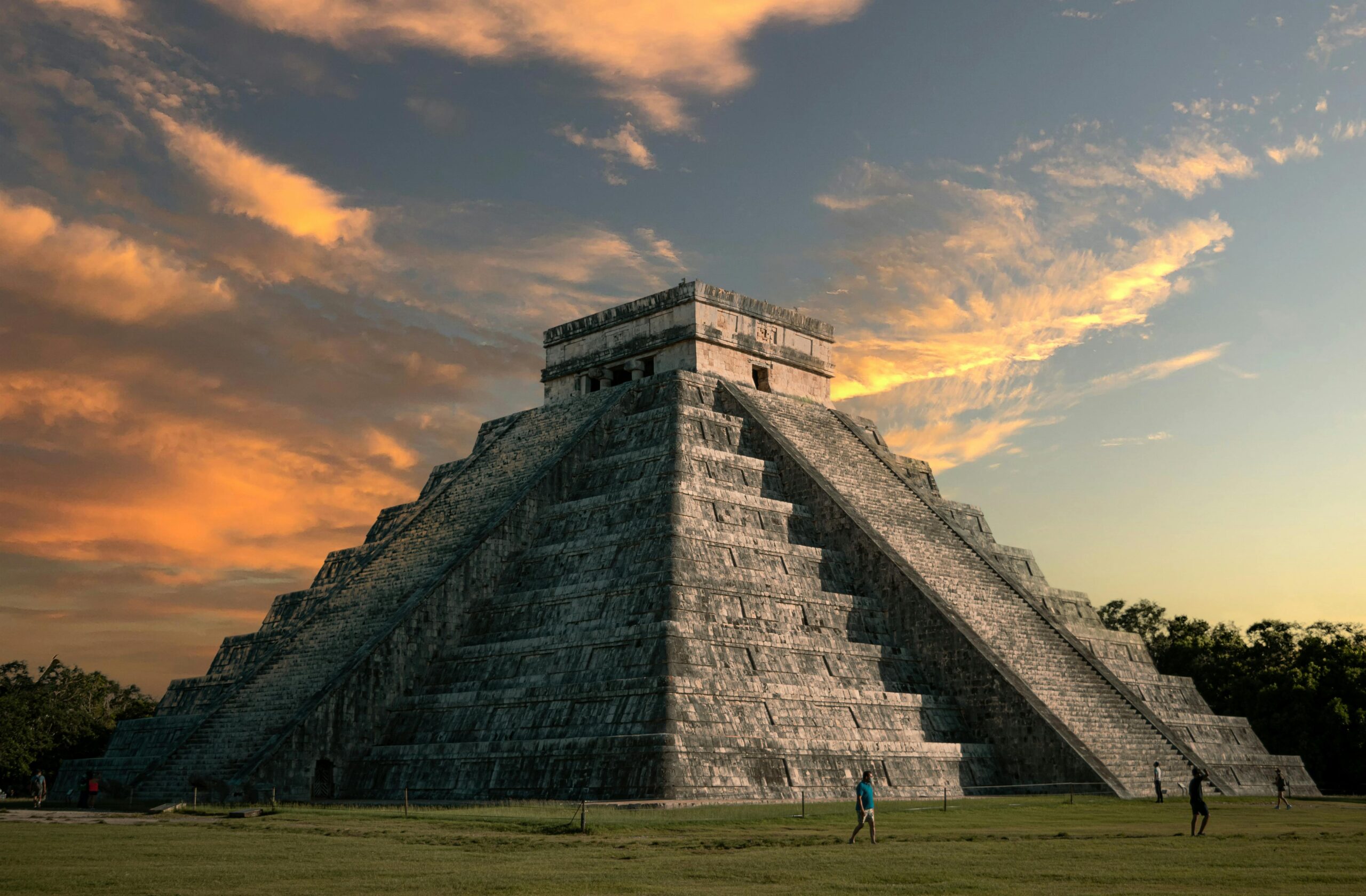
Three weeks into Lent last spring I traveled through a strange cosmology. Almost nothing was familiar: not the other tourists on the bus, not the sere landscape out the window, not the Mayan culture I’d traveled 2,000 miles to see. But almost nothing is not the same as absolute nothing. One thing was familiar: the bus. My bones and soul recognized the cocooning comfort of its rock-a-bye motion.
On schedules as regular as the clock ticking over my mother’s kitchen sink, buses belched past our house on Weber Street in Bridgeport, Connecticut. Buses ferried me to freedom from that confining little house, and buses boomeranged me back. Buses transported me to the beach, the library, and my soul-crushing high school where grim nuns hectored about Latin’s passive paraphrastic. And later, buses took me to the train station, so I could get to New Haven and take another bus to Albertus Magnus College for undergraduate school.
During those later school years, I never paid my fare and took my seat without intending to open a book and study. Aeschylus in Greek, Chaucer in Middle English, the poems of Gerard Manley Hopkins in his exquisite sprung rhythm — all I had to do was open a book and study. But I never did.
Instead, I released my mind to meander among the lives I spied from the window: the changing fashions in the windows of Read’s Department Store, the sweaty men pounding metal in Bridgeport Brass, Friday-afternoon whores trolling East Main Street. Looking, I was always looking: but for what? Something beyond the constraining circumstances of my young life? Yes, surely that. Some salve to transform the acne-faced girl the bus’s window reflected back at me? Yes, absolutely that. Or perhaps simply some assurance that one day she would step into the churning hurly-burly she saw out the window and be just fine? Yes, most definitely that.
At times, my mind slipped so far away, my self-awareness dimmed to a faint afterglow, and I entered a dimension of unsegmented white time, where l melded into Bridgeport’s grit and variance. I was in that space, but not of it: I was decorating the windows, but never pricking my finger; pounding the metal, but not sweating; walking the streets, but keeping my innocence.
Now, when I look back, I realize how much that dissociative experience was akin to the escapist pleasure I derived from reading. On my twin bed back on Weber Street, I could explore Treasure Island or be carted off to the guillotine but also be safe. Ensconced on the bus, I could absorb Bridgeport’s hurly burly but never drown in its frenzied tide.
Since those Bridgeport days, I’ve had three books, and several dozen short stories, essays and book reviews published. In other words, I have been a writer long enough to recognize this experience of unbidden white time as the source of some of my best inspirations. I’ll be writing, hit a wall, try one solution, then another, but the wall will remain impenetrable. And then my mind will slip into numinous white time — the writer Elizabeth Gilbert identifies this state as eudaemonia, “that exhilarating encounter between a human being and divine creative inspiration.” For me, the experience is like wakeful sleep, but unlike sleep, no nightmares lurk in white time. Rather, there is only a passive state where worldly concerns and bodily awareness fade, and where, while remaining wholly myself, I am cosseted in benign illumination. How long do I stay there? As long as it takes. What do I see there? Whatever passes before me. All I know is that whenever I emerge, the solution to my character’s and my own writerly dilemma frequently presents itself — a gift given outright. Like grace. So maybe white time is divine after all.
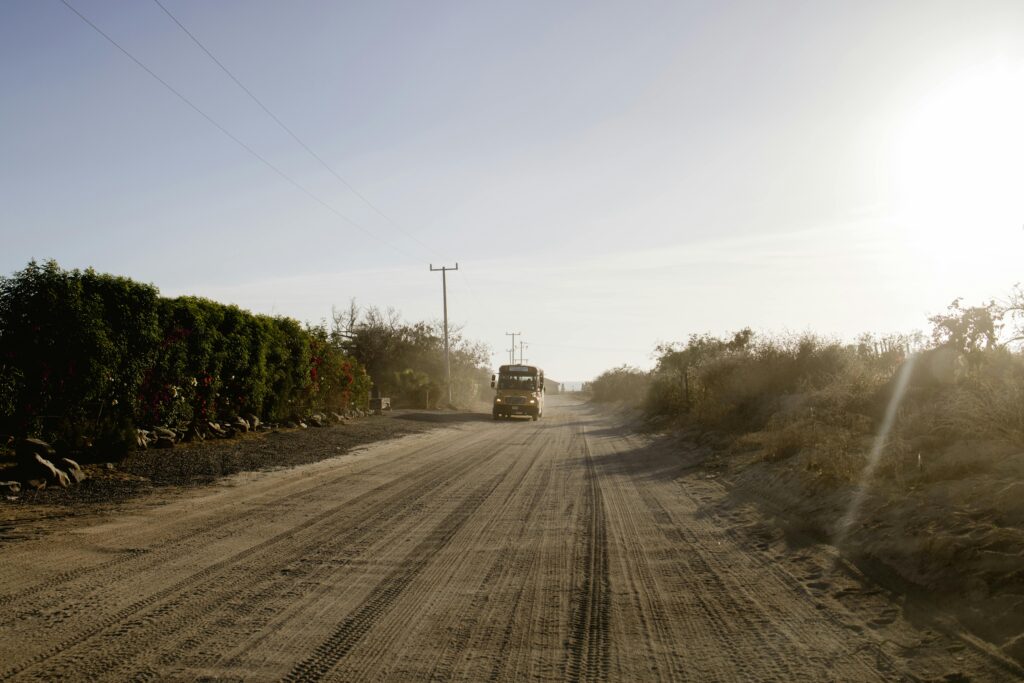
Aside from one other person on my tour through the Yucatan, I was the only person traveling alone. Sixteen years earlier, my husband of 41 years and my boon traveling companion had died. Bill was a historian and traveling with him was like traveling with a caring and learned personal guide: Stonehenge, the Colosseum, London’s war rooms, Bill brought them all to vivid reality. For Bill, history was the dark matter informing our present, the dark energy fueling our future. Unseen but always operative, history shaped our everyday lives and determined our future goals. For years after he died, the empty seat beside me would have been a cruel reminder of his absence, but by that afternoon last spring, my widowhood had mellowed. Yes, I still missed Bill, but I had come to accept that even though he no longer was beside me, he always was with me, always within me.
Plus, the bus’s rock-a-bye motion had lulled me into such a comfortable lassitude that even the homunculus of green anxiety that usually sits on my shoulder had pulled his cap over his eyes for an afternoon nap.
Our group had done a lot that day: left the hotel at 7:30; visited a pyramidal Mayan calendar; went for a boat ride to see flamingoes, then through a primeval mangrove forest where a crocodile lounged on a sunny log— the Maya believed that the Milky Way was a crocodilian god — then we had lunch in a seaside restaurant and a swim in the Caribbean. Now we were returning to our base in Merida.
But the trip back was long, and, unlike Bridgeport’s rich panorama, the view out the window was relentlessly monotonous. The vast Yucatan peninsula is a limestone plain without a single lake or river. And by early spring, the long dry season had wrung every spec of green from the parched landscape. Prickly, leafless scrub grew almost to the curb’s edge and here and there patches of white limestone poked through the fallen crumbled leaves. Those white patches reminded me of bones.
Still, I kept looking out the window, searching for affinity. I wanted some portal into the Maya cosmology. I wanted to see the landscape through a Maya lens, experience the world through a Maya sensibility, measure my soul through a Maya morality. But my own Judaic/Christian/Western cosmology kept getting in the way.
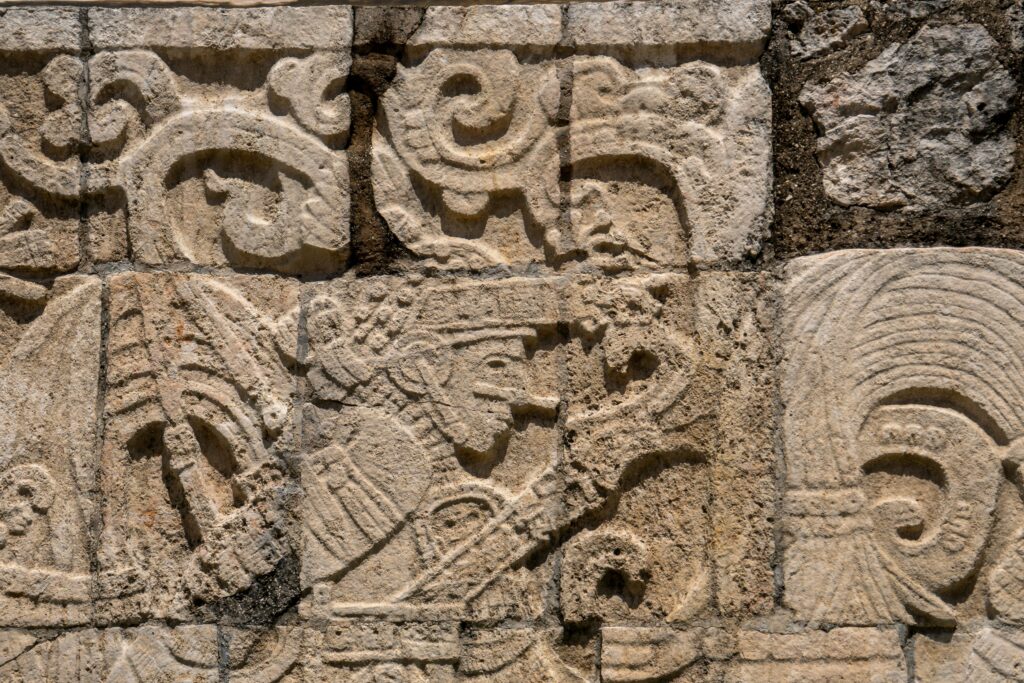
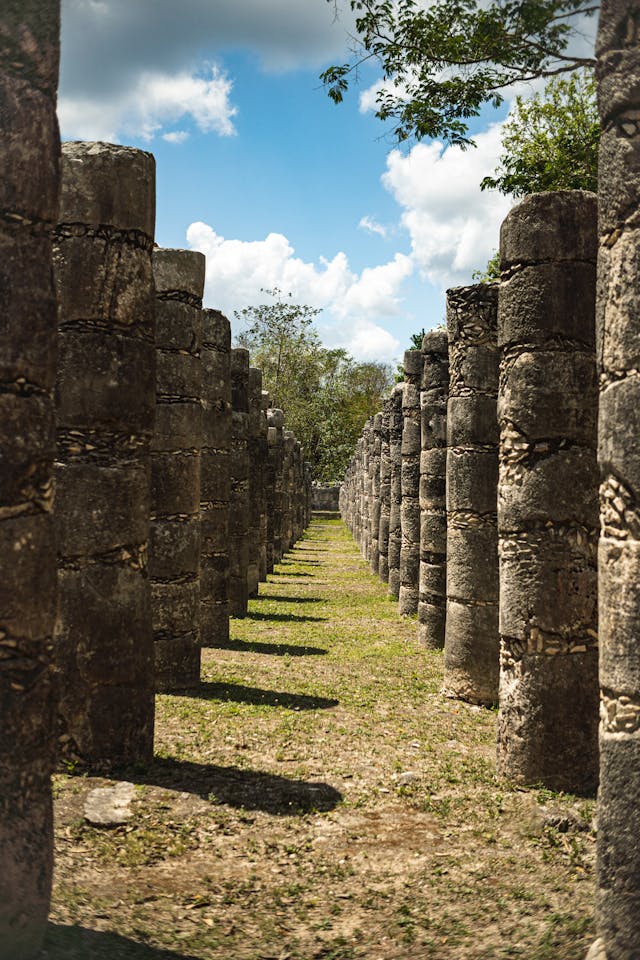
With their religious authority distinct from their civil government, logophonetic system of writing, and dazzling artistry in clay and stone, the Maya were a very sophisticated people. But no matter how many books I read, or artifacts I gazed at, or ruins I visited, no respondent recognition sparked an affinity in my heart. Try as I might the Maya cosmology remained impenetrable to me.
But perhaps I wanted that barrier. Perhaps I sensed that if I opened the portal to the Maya view of the world I’d have to confront the one question I didn’t want to know the answer to. So, I only permitted myself to ask How. How, with no rivers or lakes, did the Maya get fresh water? How, while operating under two calendars. did their society function smoothly? And how, without wheels, did they transport the huge stones to build their pyramids? But I never asked Why. I couldn’t permit myself to ask that without admitting my own dark nature, without admitting that if somehow I time traveled deep into the ancient Yucatan and met a feather-bedecked Maya, the one trait he and I would recognize in each other was blood lust.
The Maya practiced blood sacrifice, gruesome rituals presided over by a priest. Atop a monumental pyramid, four old men held down a victim’s limbs, while a fifth extracted the victim’s still beating heart and held it up to the sun. And I knew that I, too, would reach into a victim’s chest and pull out their heart, if doing so meant that the heart of someone I loved would keep beating as long as I needed it to.
In that little house on Weber Street, the twin bed across from mine belonged to my beloved older sister Sally. And when Sally died of liver cancer at age 55 a tectonic fury engulfed me. For years, I raged for answers to questions that had none. Why does the sun dare rise when Sally is gone? Why do the seasons presume to change? Why wasn’t my love strong enough to stop Death? So, yes, I know the blood lust that drove the Maya to drag victims up their pyramids. I know the desperate belief that a desperate act can restore the universe, reset the rhythm of an aching heart, replenish the well of hope. If I could have ripped out someone’s heart and held it up to the sun to have Sally back I would have done it. And I would have done it again to bring back Bill. I wouldn’t have thought twice.
All during the long ride back to Merida, I’d been seeing abandoned work sites. Amid the leafless, thorny scrub, suddenly there would be an unfinished fence or a pile of rusting tools. “Like everyone took a lunch break and never came back,” a fellow tourist later commented. Resting my head against the window and not looking for anything in particular, I noticed we were approaching some sort of electrical installation. A bunker-type building with a splotched metal door and looping cables sprouting from its roof. As we drew closer, I saw an upturned wheelbarrow, plastic tubing and metal piping lying about. The building was close to the curb. But closer, still, nearly at the curb’s edge, was a square, concrete box, just under three feet on each side. But plum and square. And white.
And propped against the box’s side closest to the highway was a cross. A crucifix. With an agonized Jesus nailed to it. He was the shade of alabaster. Of bloodlessness.
None of my fellow travelers saw it; at least none of them remarked about it. My experience, as we zoomed past, lasted only a few seconds. Yet, some teleology had directed my eyes to look not out at the scrub, but down at the curb. More than the unexpectedness of seeing that cross, or of the delicate figure of the alabaster-colored Christ, I was struck by the deliberate care someone had taken to place it there. They had risked their life. Less than a foot separated the crucifix from the curb, and a swaying vehicle like our bus could have caught them by the cuff and dragged them to their death. So why did they do it? To commemorate someone who died? Yes, that’s a possibility. But I also discerned a degree of assertiveness in the way the cross was positioned. As though someone were urging me, “Look at this! Look hard! Does not the crucified Christ evince mankind’s common bloodlust? Is not sanguinary thirst at the foundation of our humanity? Are we all not parched for blood. Of course we are. Just ask Cain. Just ask the jeering crowd lining Christ’s way to Calgary. Just ask the truth of your own heart.
Two days after I saw that roadside crucifix, our group boarded the bus for Izabal, where Mayan pilgrims once venerated the god Zamna. According to some scholars, when the Spanish arrived in Mexico in1519, they hoped that by overlaying Christianity atop sites the Maya already considered sacred sort of spiritual transference would occur. So, perhaps it was Zamna’s truncated pyramid we walk over when we visited Convento de San Antonio de Padua that third Sunday of Lent.
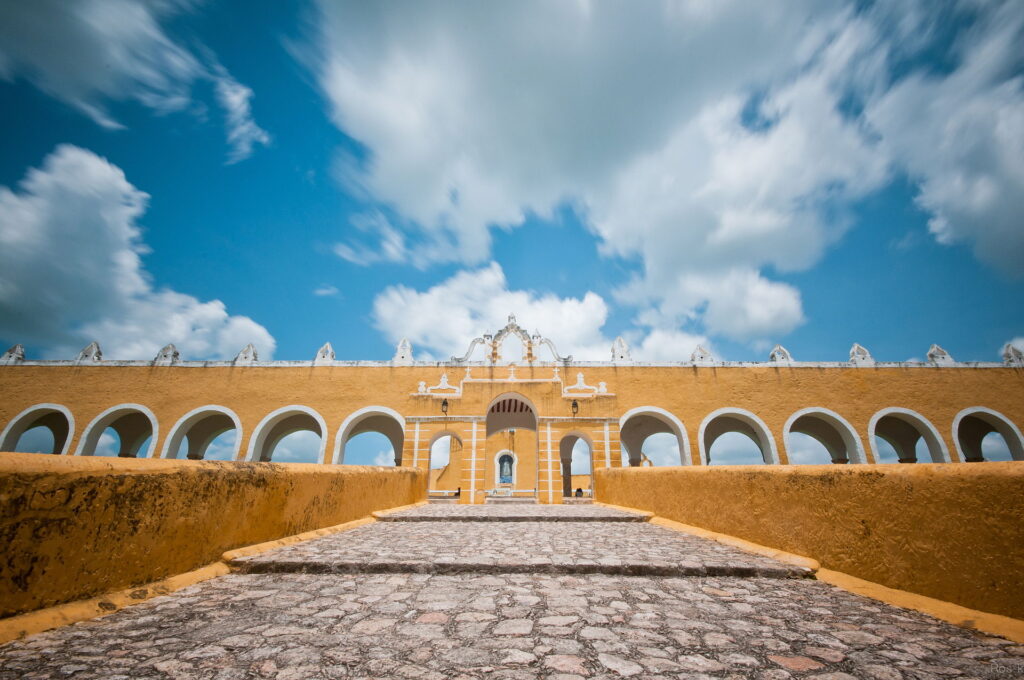
The Convento’s vast, grassy atrium is enclosed by a multi-arched portico with many doors. One opened to a chapel where Mass was being celebrated. I stepped inside and immediately felt transported back to my Catholic past, back to the time when every space in every pew at every Mass in Bridgeport’s St. Ambrose Church would have been filled. The chapel’s magnificent altar piece is a huge, gilded frame surrounding several paintings, and when time came for communion, I knelt under the one of Mary and her son. Across his mother’s lap, Jesus lay. The virgin and her blood-drained boy. The priest approached me, held out the golden chalice, and said, “La sangre de Cristo.” I nodded “Si,” and drank.
And was this ancient ritual also not an expression of blood lust? The horror and the glory, we humans drink it in. Across millennia and cosmologies, it links us one to the other. Perhaps that is why we travel. We hope seeing something new will distract us from looking inward to our true natures. Or perhaps we hope to escape the question whose answer we would rather not know.
Modern-day tourism has its foundation in Medieval spiritual pilgrimages. Even during the savage Crusades, Christian pilgrims journeyed to Bethlehem, Muslims made the hajj to Mecca, and Jews visited the Cave of the Patriarchs. All of them seeking renewal for their souls and all of them hoping to return home as restored, improved versions of their former selves — the very word “tourism” suggests this idea of return; it originates from “τόρνου,” Greek for lathe. On a pilgrimage, whatever has dimmed the traveler’s inner light is shaved away, and supposedly a refreshed, brighter individual returns home.
Admittedly my trip to the Yucatan was never meant to be a spiritual pilgrimage. Nevertheless, I had hoped to come home enlightened by another cosmology. But the truth is that I returned home pretty much the same as when I went. Maybe I was a little more informed, but I wasn’t truly enlightened. Maya culture remained a civilization removed, as impenetrable and beyond any respondent recognition as when I set off.
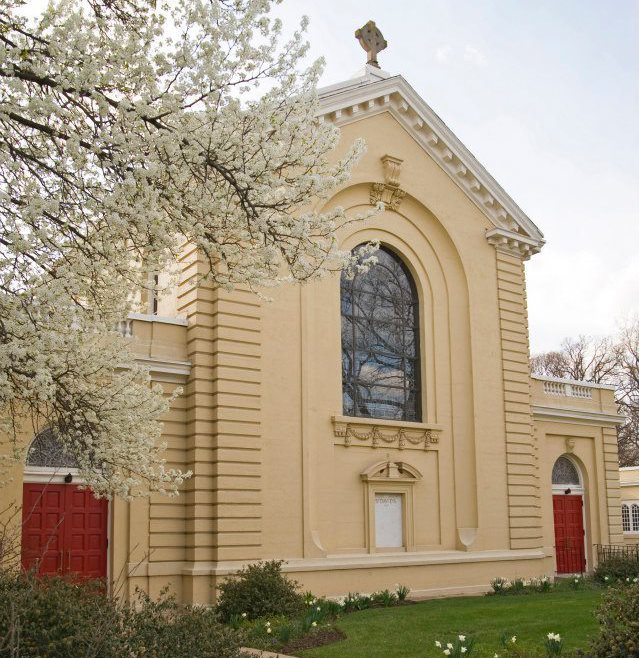
The second Sunday after I came home was the fifth Sunday of Lent, and I went to church. Since leaving Bridgeport sixty years ago, I have lived in Baltimore, and in the mid-Atlantic, springtime is like Ravel’s Bolero: slow, languorous, but ever-building to a stupendous crescendo. So, that morning I walked past forsythia already yielding to daffodils, and eager tips of early tulips pushing up toward the sun. I went to St. David’s Episcopal Church — Episcopal masses are very similar to those of Catholics, but the homilies are much better. That Sunday the rector read the gospel, then mounted the pulpit, and suddenly catapulted me back to that little house on Weber Street. He began with chickens. And I know chickens.
Our little house only had four rooms, but its yard was large. And for many years, part of that yard was fenced off so a dozen chickens or so could roam and peck. My parents were first-generation Americans whose own parents had emigrated from Poland, and perhaps my parents’ affinity for the gifts of the soil had its roots in the steppes of Poland. Or maybe the scarcities of the Depression and World War II had imprinted them with the need for self-sufficiency. So, yes, I knew that chickens can be a ready supply of eggs and roasts.
But the specific chicken the rector told us that Sunday about had nothing to do with omelets or Sunday dinner. Rather, she had to do with blood. And love. Her name was Liza, and she was a white bantam hen, a breed of chicken with eggs as small as marbles, and tiny bodies that could scarcely make a sandwich, let alone Sunday dinner. Sometime, when I was in elementary school, my father bought Sally and me bantam hens just like Liza. And, like Liza, our tiny bantams couldn’t share the coop with the larger Rhode Island Reds who would have pecked them to death. No, our bantams had their own special coop.
Liza, the rector told us, also had her own special coop, where she eventually had six chicks. And then, when her chicks were strong enough, she and they were released to strut and peck about the yard where the other hens were too busy with their own strutting and pecking to bother them. But then one sunny afternoon, a shadow suddenly darkened the yard. High above, a chicken hawk circled. Immediately, the larger hens fled to the shelter of their coop. And Liza fled to hers. But her chicks, innocent of the impending danger, stayed behind. Liza had nearly reached her coop when she noticed she was fleeing alone. So, she stopped. And doubled back. And spread her protective white wings over her brood, willingly sacrificing herself for them. And then the chicken hawk swooped down and grabbed. But Liza’s tiny body was camouflaged by a large fluff of feathers, so that’s what the chicken hawk flew away with: white fluffy feathers. But not Liza.
And then, I knew what I had been searching for all those hours on the bus. And why at that precise moment they needed to, my eyes had looked not out at the parched landscape, but down at the alabaster cross: I was meant to see what I saw. “If you want to know what really living looks like, look to the Cross,” the rector continued, “it looks like death, but that’s because we too often confuse being physically alive with living. The lesson of the Cross is that when we lay down our wings to save someone else, that is when we truly take flight.”
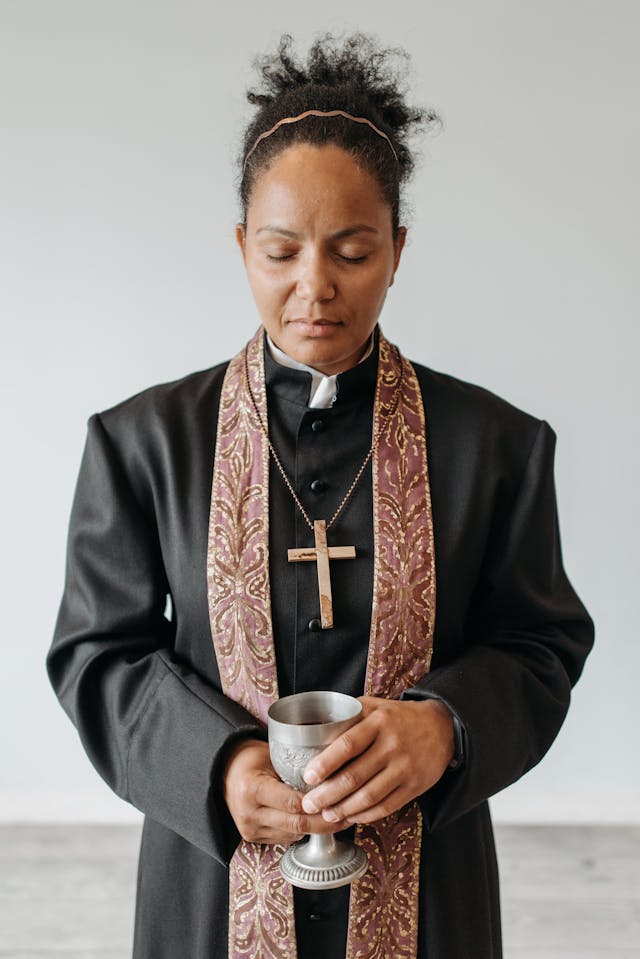
At communion, he offered me the golden cup, murmured “Blood of Christ,” and again, I took it and drank. The communion cup is called “the cup of salvation.” But sometimes salvation can come from insight. And insight can come from looking down. Yes, the Maya practiced blood-sacrifice, but they also practiced self-sacrifice. Not all the people who climbed to the pyramid’s peak were captives. Some climbed willingly, knowing their one death could redeem the lives of all those they loved down below. Just as Christ did when he climbed up Calgary and mounted his cross. That one heroic act two thousand years ago formed the foundation of the cosmology that has driven me to communion rails in Bridgeport, Baltimore and Mexico. It’s the cosmology I was given, just as the Maya had been given theirs. Perhaps the time had come for me to stop searching and just be grateful.
“The divine can mean no single quality,” writes William James, “it must mean a group of qualities . . . different men may all find worthy missions. Each attitude being a syllable in human nature’s total message, it takes the whole of us to spell the meaning out completely.”
Yes! I thought. A whole galaxy of religious beliefs — heavenly crocodiles, crucified men, wine turned to blood — each a single syllable in humanity’s effort to write the meaning of its existence; each of us, a single syllable in a narrative whose ending is far from clear; all of us riding on this middling planet hurtling through the darkness of space toward a light we perceive only dimly. All of us journeying on the slipstream of grace. All of us, pilgrims traveling on the trips of our lives, until the one day each and every one of us is well and truly home — the place we were supposed to be all along.


Beautifully written, insightful, and surprising.