
Do angels exist? Demons? Is the human psyche inherently good or evil? Are there other dimensions brushing against our own? What happens when we die, and are we somehow connected to everything else that lives?
These questions have haunted human beings since the beginning of consciousness. I’m not claiming I can answer them in any final way, and I’m not trying to convert anyone. What I can do is tell you how my life forced these questions on me, and what kind of understanding I’ve built from that pressure. Three encounters in particular—one in the woods, one at the edge of violence, and one under a childhood sky—left me convinced that reality has a moral dimension, whether we call it angels and demons or something we don’t yet understand.
For years, I lived the way most people are taught to live: deep in the rat race, chasing the American Dream. I chased money, status, distractions, and the kind of things people measure a “successful life” by. I told myself that was normal. I didn’t make much room for philosophy because philosophy slows you down, and when you’re running hard enough, you don’t have to hear your own doubts.
But there were moments that stopped me cold. Some were violent, some strange, and some so personally defining that decades later, I can still feel their texture in my bones. They didn’t hand me neat answers, but they cracked something open in me. After enough close-call survival, a question becomes unavoidable:
Was something watching over me? And if so—what? I don’t pretend to know for sure. But I know what happened. I know how it felt. And I know what it did to me.
Cloudcroft, 1974
In the summer of 1974, I was nineteen years old, still in the military, on leave, and visiting friends. We were in a small cabin in Cloudcroft, New Mexico, high in the Sacramento Mountains. The village was tiny, at about nine thousand feet above the desert. If you’ve ever stood that high at night, you know the sky looks different—cleaner, sharper, nearer, as if you’re not looking up at space so much as standing inside it.
There were maybe twenty-five people at the party. Heavy drinking, weed, and other drugs going around. The cabin had one bathroom, so when I had to relieve myself, I stepped outside.
The forest around the cabin was thick and dark. There was no light except moon and stars, and I remember pausing to look up. The night sky was unfiltered and endless. For a moment, everything felt peaceful, even holy, in a way I didn’t have language for yet.
Not sure if I needed more than a quick piss, I walked a few yards into the woods, far enough to be out of sight. I was alone, and it was dark enough that at first I couldn’t see anything.
Then I saw two huge red eyes, maybe forty or fifty yards away. My first thought was animal. Something watching me. That didn’t scare me. I grew up around woods. But then the eyes moved to my left and started coming toward me. They weren’t blinking. They were getting brighter.
I finished my business and—more curious than afraid—took a few steps toward the eyes, trying to scare whatever it was away. But they kept coming. They picked up speed. And they were moving silently, like whatever was attached to them wasn’t touching the ground.
That’s when instinct cut through intoxication and curiosity. The kind of instinct you don’t argue with. I turned back toward the cabin—and realized I couldn’t see it.
My inebriated state probably didn’t help, but I had wandered farther than I thought. I couldn’t tell which way the cabin was. I turned again to look for the eyes.
They were gone. I started walking in the direction I thought the cabin should be, but I was wrong. I was going deeper into the woods. When that sank in, I turned around.
And the eyes were back—this time only five or seven yards away.
Now I could see a figure around them. Huge. Dark. Standing upright, tall as a doorframe. It looked like it should have been on four legs but wasn’t. I couldn’t make out details except the skull shape and those red eyes set inside it like embers. In those black woods, we just stared at each other for what felt like forever.
Back then, I always carried a sharp eight-inch hunting knife. I got it out. Not because I believed I could defeat something like that with a blade, but because it’s what a man does when he’s cornered and still alive. Training and pride take over when there’s no other option.
The figure moved toward me. Quietly. Fast. It crossed that short distance in two strides and was on me.
Here’s the strange part: I don’t remember fear the way people usually describe it. The mind does odd things when it thinks the world is ending. The last thing I remember clearly was a smell—like a smoldering fire burning a rotted carcass. Thick, hot, and wrong enough to make my stomach turn.
Then nothing.
I woke up lying in the grass near the cabin beside my rental car. It was almost daylight. I felt violently sick and sore, like I’d been thrown around. I checked myself for wounds. I couldn’t find any. My knife was still in my hand, coated with a clear sticky substance I couldn’t explain.
I walked up to the cabin angry nobody came looking for me, expecting chaos or concern, and found it basically empty. Only a couple people were sleeping near the fireplace. Everyone else had left. Even my girlfriend was gone.
I sat on the steps smoking a cigarette, staring into those woods, trying to understand what had happened.
Over the years I’ve gone back and forth about it. I know the obvious explanations: intoxication, a blackout, a hallucination, some half-dream made of shadow and grief. People I’ve told about it have said as much. Maybe they’re right. I can’t audit my nineteen-year-old brain from here.
But this is the truth as I lived it: it felt more real than any dream I’ve ever had. It has the hard edge of memory, not the fuzzy edge of fantasy. And even if it was entirely internal, it still marked a turning point for me. Because after that night I couldn’t pretend life was only the surface.
At nineteen I was spiritually lost. I had just lost my adopted father to cancer. I was angry at the world, angry at myself, and headed down a path I now recognize as self-destruction. I didn’t have words for it then, but in hindsight I can see I was walking toward darkness, inside and out. I don’t know what that thing in the woods was, but I do know the experience forced me to look at my life differently. It made me wonder whether there were forces in the world—call them spiritual or psychological—that move a person either toward ruin or toward redemption.
That’s where the old moral vocabulary started to feel less like myth and more like a map.
The “Pressure” Moment
A few years later I was still traveling down that darker road. Survival alone doesn’t guarantee wisdom. Sometimes it only feeds arrogance. I was quick to violence, quick to pride, quick to revenge. Once that momentum locks in, it isn’t easy to stop.
One night I went to someone’s house planning to take revenge over some insult I can’t even remember now. I was waiting with a lead pipe in my hands. I remember the crunch of gravel under my boots, the porch light washing the hood of his car as he pulled in, and my pulse hammering in my ears like a drum. I was ready to hurt him badly.
As I started toward him, I felt a crushing pressure on my skull—as if a massive hand clamped down on my head from the outside.
It wasn’t a headache. It wasn’t a migraine building from inside. It felt external, immediate, and terrifyingly strong, like something had grabbed me to stop me.
I backed off, stumbling to my car. The pressure got worse. I don’t remember driving away.
My next clear awareness was sitting in the back seat of my car in my apartment complex parking lot several miles away. Dawn was coming. The crushing force was gone, but I had a severe headache and a kind of stunned emptiness that’s hard to put into words. I felt reset against my will.
I’m not claiming I know what caused that. I’m only saying what happened: something stopped me that night in a way my normal psychology doesn’t explain. If you want to call it conscience, shock, dissociation, or some emergency braking system of the mind, I understand. But to me it didn’t feel like my own will stepping in. It felt like an intervention.
And because of Cloudcroft, I already had a word for intervention:
Guardian.
What I Mean by “Angels” and “Demons”
Let me be careful here about the kind of claim I’m making, because this topic can turn into noise if people aren’t clear.
What I know: I’ve had moments where reality felt pierced—where something more than ordinary life seemed present. Those moments changed my trajectory.
What I infer: Those moments pushed me toward a moral model of the universe. Not a model where good and evil are just opinions or social agreements, but one where certain states of being pull us toward life and love, and other states pull us toward cruelty and ruin.
What I speculate: Those forces may be literal non-corporeal beings, or they may be energies or intelligences we interpret through old language. “Angels” and “demons” might be real entities in a spiritual sense. Or they might be names for the way benevolence and malevolence move through a conscious universe. The labels differ across cultures; the pattern doesn’t.
Across history people have reported benevolent guides and malevolent hinderers. We’ve called them gods, spirits, guardians, ancestors, demons, djinn, tricksters, watchers—names change with culture, but the lived sense of “something assisting” or “something feeding on destruction” stays remarkably consistent.
If something protects, encourages, or turns you away from self-ruin, we call it angelic. If something fuels hatred, addiction, violence, or despair, we call it demonic. Whether those are beings outside us or currents inside us, the effect on human life is the same.
In my case, the “good” force didn’t feel like a moral lecture. It didn’t feel symbolic. It felt like pressure, presence, and survival—like I was being prevented from becoming something worse than I already was.
God, Free Will, and Evil
In my youth, one of the reasons I resisted the idea of a Creator was the problem of evil. I’m a history enthusiast. I’ve studied genocide, cruelty, slavery, famine, war, the endless catalog of human suffering. If a good God exists, why does all that happen? Why are people allowed to hurt each other so badly?
I don’t have a neat answer. Anyone who claims a clean explanation for suffering is probably selling something. But the only answer that fits both life and conscience is free will. If humans are meant to be real moral beings, we must be able to choose. And that means we must be able to choose wrong. A world without the possibility of evil would also be a world without courage, sacrifice, resistance, or redemption. It would be a puppet show.
That doesn’t excuse suffering. It only explains why a moral universe might allow it. Evil can still be evil without being a decisive objection to God. If anything, the fact that we recognize evil as evil—rather than mere taste or preference—suggests morality is more than a human invention.
As I researched and lived and failed and recovered, I stopped picturing God as a cosmic manager micromanaging billions of lives from behind a desk. That image never made sense to me. Instead I began to think of God as more fundamental: the source, the creative essence behind existence itself.
To me, the Big Bang looks like creation on a scale so profound that “God” is the closest human word I have. I don’t pretend to understand what existed before it. I just don’t believe the universe came from nothing for no reason. The order of nature—the way physical laws hold across unimaginable distances, the way life grows toward complexity, the way consciousness emerges at all—feels like the stamp of meaning. Not meaning we manufacture, but meaning we participate in.
If God is the essence behind everything, then every living thing is part of that essence. And if reality is moral at its root, love isn’t an accident. Love is the dominant direction of being.
That idea gets practical fast. Love is what makes people sacrifice for each other, forgive, restrain themselves, build instead of burn. Love isn’t soft. Love is the force that keeps humanity from collapsing into its worst instincts.
Consciousness and Connection
I’m not going to drown you in physics. I’m not a physicist. But I will say this: modern science has opened doors that used to belong only to religion. At the smallest levels matter behaves less like solid objects and more like probabilities, vibrations, relationships. Reality is stranger than our senses. Our eyes and ears capture only a sliver of what exists.
That doesn’t prove angels. But it does give a humble person permission to admit we may not see the full architecture of the world. Maybe consciousness is more than a byproduct of brain chemistry. Maybe awareness is woven into reality itself in ways we’re only beginning to understand.
My working model, built from experience more than lab results, is this:
The universe is not dead.
Consciousness may not be confined to brains; it may be a property of reality.
The more attuned a person becomes to love, intention, and awareness, the more connected they are to that universal consciousness.
Call that God’s presence. Call it the field of love. The name matters less than the lived fact that some states of mind open us to benevolence, while others open us to destruction. Every one of us knows this personally. When you’re full of rage, you see the world one way. When you’re full of compassion, you see it another. The question is whether that shift is purely internal, or whether it tunes us into different layers of reality. My life has pushed me toward the second possibility.
I’ve experienced altered states—near-death edges where the world felt thinner, as if another layer was close enough to touch. Those edges didn’t make me holy. They made me careful.
A Childhood UFO
When I was about ten or eleven, my adopted parents used to visit my grandparents’ mountain homestead in middle Tennessee. Early 1960s. No electricity. No indoor plumbing. Nearest neighbor half a mile away. At night the world went pitch black—the kind of black city people don’t know exists anymore.
One evening just before bed, all of us saw a bright flashing pinkish-red light above the house. We thought lightning at first, but it wasn’t. It didn’t spread or echo. It pulsed.
The men stepped into the yard to get a better look. We kids followed, because kids follow.
About fifty feet above the house hung a huge silver circular object, bigger than the house itself, radiating bright pink and white lights, perfectly silent, hovering in place like it owned the sky.
We stared for seconds that felt like minutes. Then adult fear kicked in. The kids and women were shoved inside. My Uncle Earl grabbed his shotgun and fired.
The lights flared brighter for a split second and the object drifted away over the trees, still silent, like it was sliding through water. Then it was gone.
We were told it was a lost airplane.
Even at ten years old I knew that was a lie.
I didn’t talk about it much afterward. Not because I forgot, but because there’s no point arguing your childhood memory in a world that already decided what counts as “real.” But that sighting lodged in me like a splinter. It widened the box. It forced another question into my worldview:
If something not human can be in our sky, what else is real that we don’t understand?
Other Intelligences, Seen and Unseen
Here I step into open speculation, and I label it that way on purpose.
The universe is old and vast—billions of galaxies, trillions of stars. We already know planets are common. Many of those planets are likely in the right zones for life. It seems unlikely Earth is the only place where God’s creative essence produced intelligence. If biology followed physical laws here, it likely follows them elsewhere. Life might not be a cosmic fluke. It might be one of the universe’s natural outcomes.
So what are the “others”? A few possibilities:
- Physical extraterrestrials: beings who evolved elsewhere, perhaps far older than us.
- Dimensional intelligences: entities existing in realities layered with ours, beyond our senses.
- Discarnate consciousness: intelligences not bound to bodies at all.
Those categories may overlap. If consciousness is fundamental to reality, there may be kinds of life we don’t even have language for yet. That shouldn’t scare us; it should humble us.
What matters here isn’t proving any single theory. What matters is that human beings, across eras and cultures, keep reporting contact with something that feels “other.” Sometimes those encounters feel benevolent. Sometimes they feel malevolent. That brings us back to angels and demons—not necessarily as medieval figures with wings and horns, but as the moral face of a wider reality.
Maybe what ancient people called angels were advanced intelligences, or dimensional allies, or manifestations of benevolent consciousness. Maybe what they called demons were destructive intelligences or parasitic energies. Maybe the truth is stranger than any one frame. The point is the moral pattern shows up wherever humans report the supernatural: the assistant and the destroyer, the guide and the predator. Whether that is an internal drama, an external reality, or both, I can’t say. But I can’t ignore the pattern either.
Death and Afterlife
My view of death has changed because I’ve brushed against it too many times to believe it is a final wall.
My body is dust and will return to dust. Every religion says that in some form, and every grave proves it. But my consciousness—my spirit-mind, my essence—does not feel like dust. It feels like energy. And one law of nature we do trust is that energy does not simply vanish. It changes form.
When the body fails, that energy releases. I don’t believe it evaporates into nothing. I believe it continues in a non-physical realm, still carrying memory, identity, awareness. Maybe that ongoing state is absorbed into a larger universal consciousness. Maybe that consciousness is what religions call heaven. I don’t pretend to map it. I only know I’m not afraid of death the way I was when I was young and angry. Fear shrinks when you accept that mystery isn’t the same thing as emptiness.
If consciousness is woven into the universe itself, then death isn’t erasure. It’s relocation.
The Meaning I’ve Landed On
So does any of this prove angels or demons?
No. Proof is a poor word for the deepest parts of life. The most important things a human knows—love, grief, beauty, terror, conscience—aren’t “proven.” They’re lived.
What these experiences have done is make a moral universe feel real to me. Every time I’ve stood on the edge of death, what has saved me—whether inner or outer—has felt like the pull of benevolence. Not because I was pure. Not because I deserved a medal. But because something in me was being restrained from self-destruction and turned toward something better.
I believe intentions matter at the root of reality. I believe love is not sentimental decoration but a structural force in the cosmos. I believe cruelty and evil are real too, but they are parasitic, not foundational. Evil feeds. Love creates. That difference matters.
Whether my guardians were true angels, the energies of a conscious universe, dimensional allies, or something I don’t yet understand, I’ve come to this:
The more a person aligns with love, truth, and courage, the more reality itself seems to align with them.
That doesn’t mean every good person is protected from pain. Life doesn’t work that way. But it does mean love is not naive. Love is the most practical spiritual technology we have. It is the frequency—if you want to call it that—that brings human beings into harmony with whatever benevolent essence underlies existence.
Maybe that’s why I survived so many times. Maybe my survival wasn’t random. Maybe I was being pulled back from the ledge again and again for a reason I didn’t understand then. Maybe that reason is still unfolding. I don’t know. I don’t claim to.
But I know what I’m called to do while I’m breathing: to transmit as much positive energy—love, mercy, courage—into this reality as I can.
If God is the essence behind everything, then love is the closest way to live inside that essence. And if billions of conscious beings choose love over hate, then the reality we make together bends toward good. Human history proves how destructive we can be, but it also proves something else: again and again, love is what outlasts cruelty. Every dark age ends. Every plague passes. Every tyranny falls. What remains is the stubborn human capacity to rebuild, to forgive, and to care.
That’s why I don’t believe the universe is ultimately malevolent. If it were, love wouldn’t keep erupting in human hearts the way it does. If God’s essence is in all things, love isn’t a side note. It’s the direction of the story.
I don’t expect anyone to take my experiences as their proof. All I ask is that you recognize a basic fact of being human: some things happen to us that crack the world open. We can explain them away, or we can let them expand us. We can reduce them to chemistry, or we can let them point toward meaning. Every person has to decide how much reality they’re willing to live inside.
For me, the world got bigger in those Cloudcroft woods. It got bigger at the edge of violence. It got bigger under a Tennessee sky with something hovering over our roof. Those enlargements didn’t make me perfect. They made me awake.
And if being awake leads anywhere worth going, it leads toward love.
Because love is the only force I’ve encountered—whether in myself, in others, or in whatever watched over me—that doesn’t ask me to shrink. Love asks me to become more human, not less. It asks me to choose life, not death. It asks me to forgive instead of feeding the darkness. It asks me to believe that whatever the universe is, it isn’t indifferent to the moral direction of a soul.
I still see those red eyes sometimes when I close mine—not as fear now, but as a marker in time. Something met me in the dark, and I didn’t stay there. Something pressed down on my skull the night I meant to become a monster, and I walked away. Something hung silently above my grandparents’ roof and cracked my certainty open so wide that I’ve never been able to close it again.
I don’t know what name the truth wears.
I only know the direction it points.
~
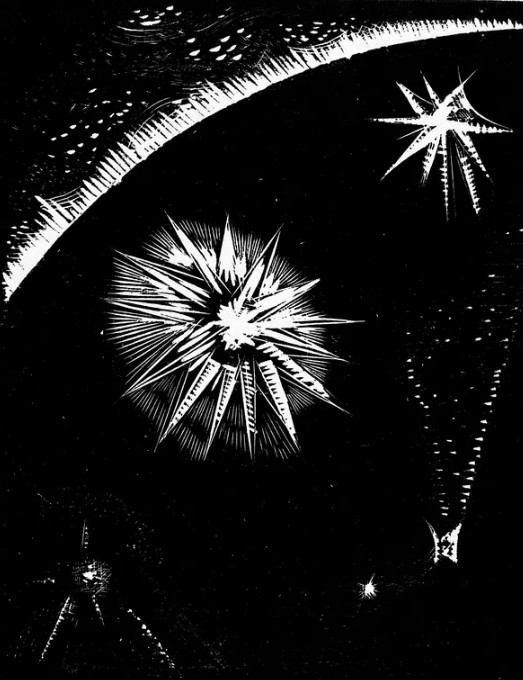
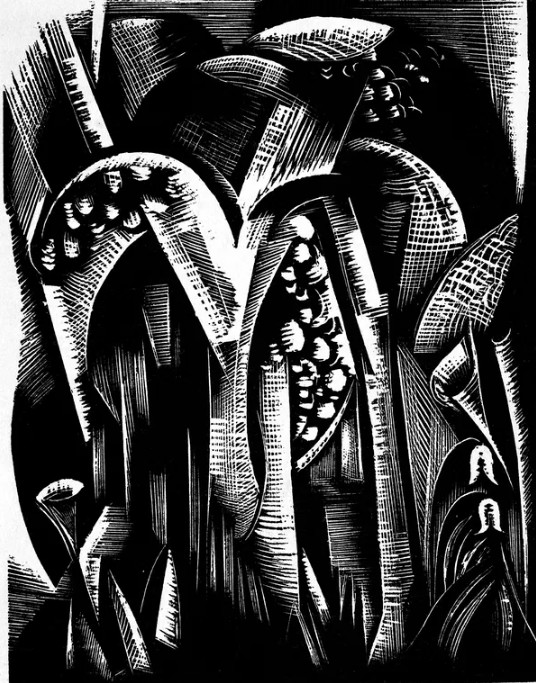
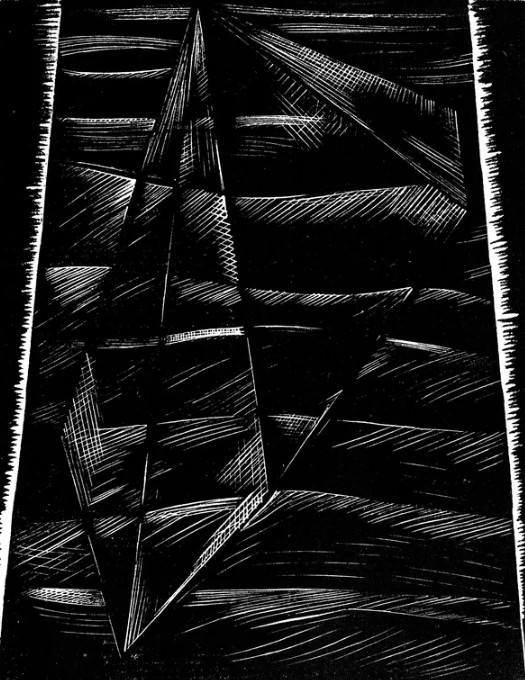
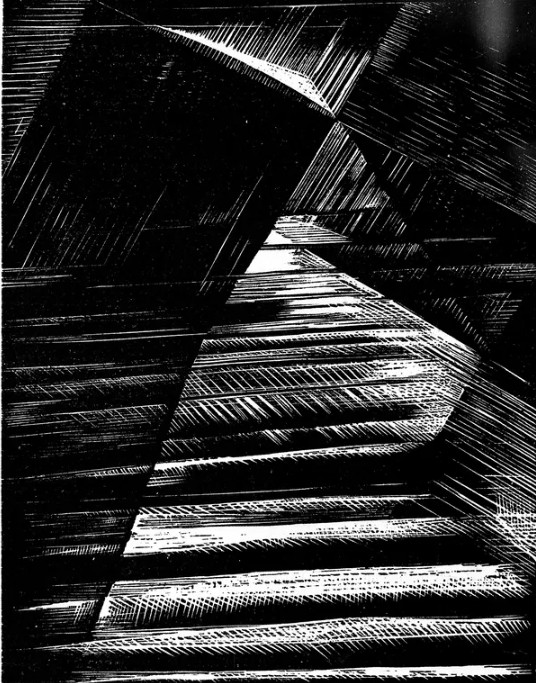
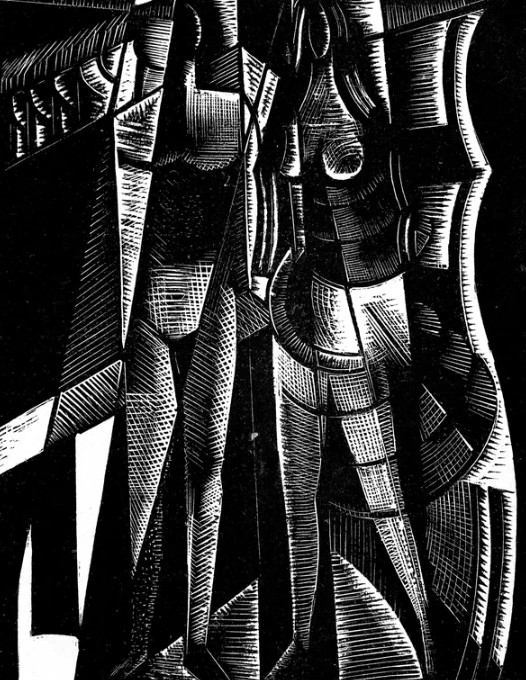
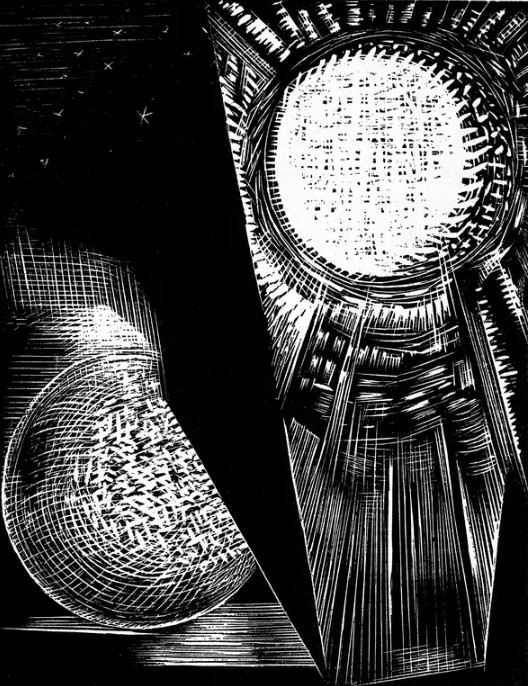
Woodcuts by Paul Nash, from Genesis 1924


I loved this article and have had similar experiences. I have thought a lot about universal consciousness. I particularly like Annaka Harris work on “Consciousness as a Field”, a fundamental property of the universe like gravity. I am also a Vietnam veteran, “Forward Observer” 1967 First Cav, which has shaped how I view the world and what’s real. Doc … lets hook up on Facebook. gkalergis@aol.com I would love to hear more about your experiences. My memoir “The Year the Greek Survived” to be published in March.
This: “Maybe that’s why I survived so many times. Maybe my survival wasn’t random. Maybe I was being pulled back from the ledge again and again for a reason I didn’t understand then. Maybe that reason is still unfolding. I don’t know. I don’t claim to.
But I know what I’m called to do while I’m breathing: to transmit as much positive energy—love, mercy, courage—into this reality as I can.”
Interesting read. Thanks for sharing. Though circumstantial experience varied greatly, soul experience has been much the same. ✨️
Donna, thanks for the comment. This essay took me through many memories and insights. It was a very rewarding process. Thanks for reading and sharing.
Blessings,
Doc