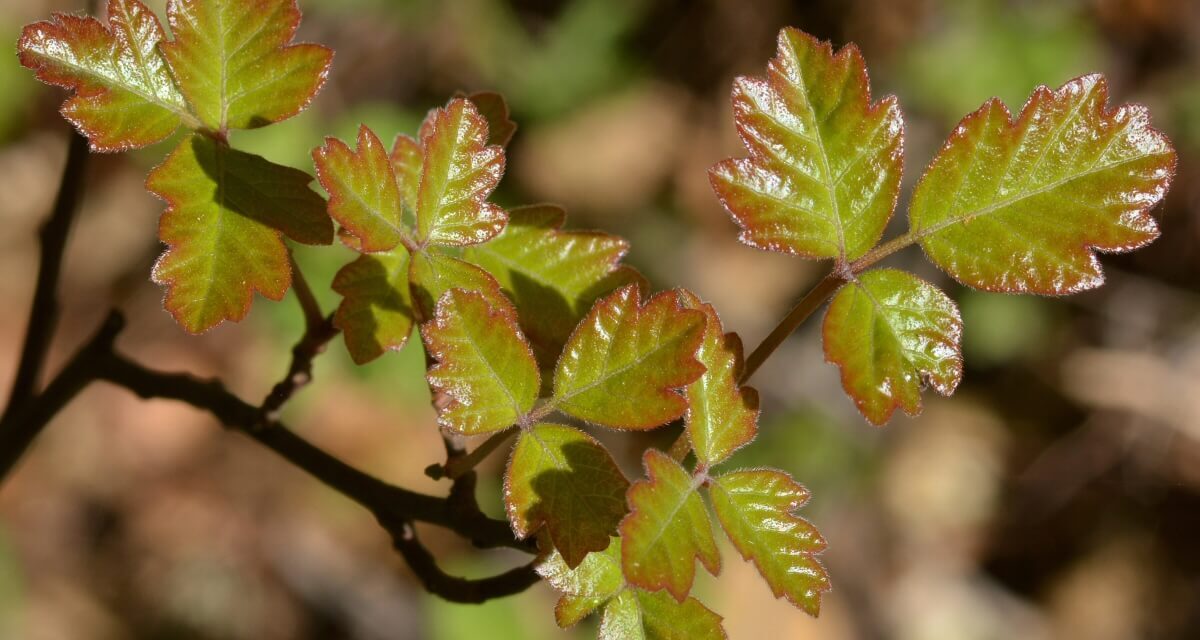
“Don’t touch the poison oak.”
Our instructor kneels down to show us the seductive, glossy-leaved plants. The tip of my shoe inches closer to one of them. “Don’t touch it!” she admonishes.
In this moment, I knew that by the end of the nature retreat I would touch the poison oak.*
Later, on a beach, our instructor sets out two hefty pine cones, an antique amber bottle, and a jagged grey rock to indicate the cardinal directions North, South, East, West. I am always drawn to the West. The
West, she explains in an ethereal voice that floats above the roaring waves, is associated with the unconscious, shadow selves, magic, monsters, and death–to name a few. To add my own: The pull towards poison oak plants. To want to love them, respect them, understand them, protect them… and touch them, if allowed.
I once heard a mushroom expert claim that all mushrooms, even the deadly poisonous ones, contain medicine in the right dose. I believe this is also true of plants. What medicine does poison oak contain? To find out, we must see beyond human-applied labels like “weed” or “nuisance,” and ask, “What’s going on here that others might be missing?” Poison oak medicine may be a call to respectful curiosity.
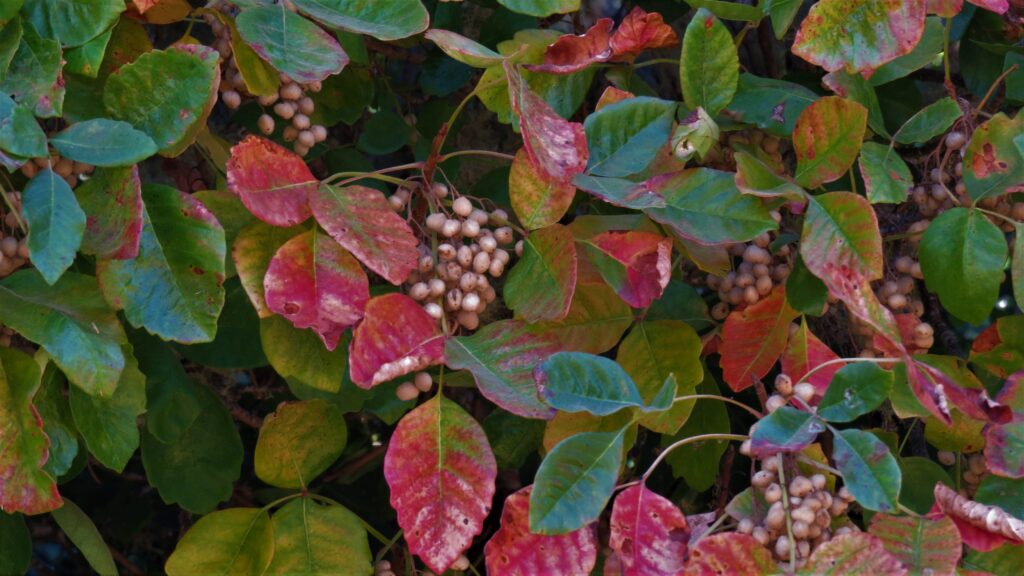
In the evening I sat on a stump overlooking a creek. Poison oak plants are abundant there. They were not ready to be touched, and I was not ready to ask. So I asked them instead what the whole rash business was about.
They said, “People leave us alone. At least they usually do, after the first or second time they mess with us.” I can understand wanting to be left alone by humans. You can’t trust most people not to take too much. I’m glad I can’t exude a silky, blister-making oil from my skin, because I probably would. Poison oak medicine may be a call to self-protection.
I told the plants about myself and my sorrows of being human. I spoke of the difficulties in making good decisions when most of the available ones in our culture are bad or less than ideal. I complained of the
complexity of working within a broken system put in place by humans hell-bent on doing evil.
They replied, “It is a great privilege to be human.” They said, “You have power that you do not yet know.” Poison oak medicine may be a call to know your own strength.
On the second day, I touched the poison oak. I was willing to blister, but had a feeling that I might be immune. And to be perfectly honest, I just wanted to see what would happen. The opportunity arose when we were encouraged to go on a solo nature walk to seek a portal place. I found myself drawn to a gently sloping meadow. There was a call, an invitation, to sit in the shade of a particular bush. But when I knelt down, I saw several poison oak plants in the spot I had been invited to sit.
Despite considering for a moment that this was probably unwise, and would likely seem unhinged to someone observing me without context (and maybe even with context), I sat. I spoke to the poison oak plants, praising their shiny deep green foliage, their occasional scorches of red that serve as a warning. As I was working up to asking for permission to touch them–- well, the ones I had not already gently sat upon–- the back of my right hand accidentally grazed a glistening leaf. Immediately–- a burning sensation across my knuckles. And then a brief but alarming hot menthol sting in my lungs.
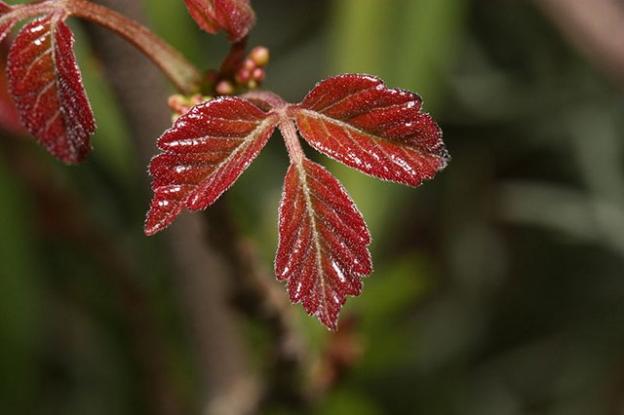
And suddenly I was a child again, rolling around on another slope, in another place, of grass mostly, with a little poison ivy. I was joyfully preoccupied with rolling, unaware that I was crushing the plants beneath me. Later I experienced the itchy, maddening, bubbling rash on my arms and legs. I had forgotten that all those years ago I had experienced that burning sensation in my lungs. Is it possible that poison oak and poison ivy
contain some undiscovered medicine for the physical body that works upon the lungs?**
“I feel your power,” I said. “Thank you.” Then I buried my late son Octavian’s fluorite crystal point next to the plants as an offering while I told them about him.
After I left this scene, I intentionally did not change my clothes. Neither did I wash the part of my hand that had touched the poison oak. Despite this, I did not blister nor suffer in any way. Maybe the plants decide how much poison you need. Or deserve. In this case, maybe just enough to let me know that we really did connect. Had I not treated the poison oak plants as important beings and noticed their subtle effects
on me, I likely would have suffered as I did when I was a child. Maybe poison oak’s medicine is a call to mindfulness?
It occurs to me that sometimes other people are poison oak to me and sometimes I am poison oak for them. If you meet poison oak, in whatever form, consider coming closer, listening harder. I will try to do the same. Let us not be afraid of what we do not yet understand. Everything is here for a reason. Everything. To ignore or eradicate that which makes us uncomfortable is a symptom of a colonized mind.
“Learning from me might be more painful than you are willing to bear right now,” poison oak says. “No matter. You will encounter poison oak again on your journey. There will be another opportunity to learn.”
Poison oak medicine may be a call for the courage to engage in difficult, necessary conversations.
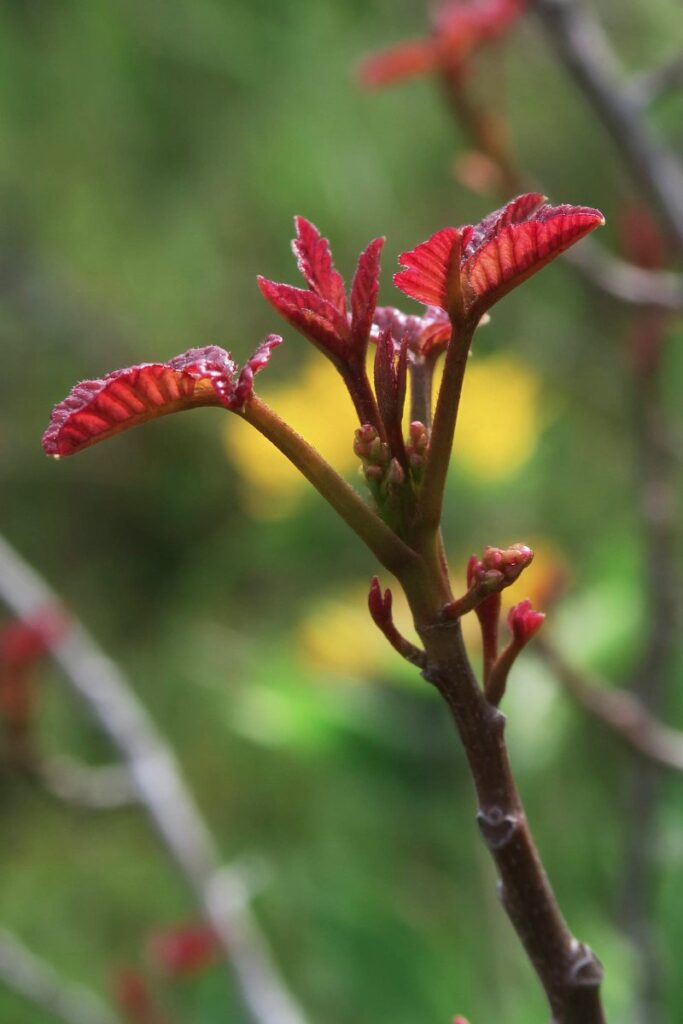
*The author is not encouraging anyone to touch poison oak.
**Some plant teachers say these plants are better referred to as “Sister Oak” and “Sister Ivy,” and that they tend to grow where
the land has been disturbed by humans and needs protection. Some online sites claim Native Americans have used poison oak as medicine in an astounding variety of applications. It’s also said some people could touch it without effect. This was presumed
to be immunity. Perhaps it is more than that.