I have cancer. On a hospital bed, I lean shoulder-to-shoulder, backs against the wall, with a white-coated oncologist. His large Mediterranean nose reminds me of my uncle’s. Your illness is terminal, he confirms. In the face of death his presence comforts me. I relax into his shoulder, into the wall, even further back, falling into a sweet, encompassing silence.
For weeks after I dreamt this moment, the silence was so near all I needed was a walk in the woods or ten minutes on my knees to be saturated again. Quiet mind, beating body. Welcome dissolution. Rest unlike any I’d known. Freedom. Peace. Tender, vibrating presence. Communion, union. True self in the form of love. The close, swelling emptiness I called God.
Silence pulsed through my being. In the dream I’d accepted an invitation: You can rest; you will be held. I no longer needed to believe this because I knew. I knew even while I was awake, going to work, cleaning the house, playing with my daughter.
Then time passed. The feeling dissipated, and my busy mind returned. What if the dream was prescient and I really was dying of cancer? Shouldn’t I do something? Prayer again became the usual scrambling only now layered with grief at losing that merciful silence. For twenty-plus years I’d meditated, which generally meant floundering through fields of swirling thoughts, clutching my breath like a guide rope, desperately wanting help from my Christian tradition and finding little, certainly never finding rest. Now, with the dream dormant in my bones, the posturing clergy, credal pronouncements, and relentless busy-ness of Sunday morning worship grew intolerable. Noise bombarded every second of the service. I returned home so snippy from seeing the theatrics of my mind enacted on stage, my wife insisted I quit. Instead I amped up the meditation, because how else might I find again that blessed quiet?
But I could not recreate what I’d tasted as grace.
Somehow—a series of coincidences, a comment from a friend leading to a podcast recommending a book I’d read two decades earlier but was now ready to ingest—I found Centering Prayer, a contemporary rendition of an ancient monastic practice from the Egyptian desert. I drank it like a thirsty pilgrim. Unlike my floundering Buddhist meditation, and contrary to everything I’d encountered in my milquetoast United Methodist tradition, Centering Prayer embraced both the fullness and emptiness of spiritual experience, what Christians call the via positiva and the via negativa. I’d experienced both in my dream: the warm shoulder of my oncologist, whose whispered voice tenderly named the truth—and utter dissolution. Centering Prayer immersed me in a divine pervasive presence which feels like absence; it ushered me into my own essential absence which seems like a presence. It unfurled before me a path back to that pulsing, trustworthy peace in the face of death.
Today when I kneel before my candle, I finish pleas for humanity’s release from suffering, for our threatened environment, for our broken democracy; I unburden myself of my longings because this is what prayer has been for me from the start, my mother beside me in bed, coaxing—“Dear God”—and still is, reflexively; I wouldn’t know what to do with my ache otherwise. Then I recite my intention: “I consent to Your presence and movement within me.” I begin Centering Prayer. As soon as I notice my thoughts, I use a sacred word to return to my intention. Mercy. A sacred word is like a bone you throw to your enthusiastic mind. You’re to rest in open-hearted stillness, which I don’t ever; I just think and throw bones. The teachers say this is enough. I try to believe them.
Mercy is not the word I would have chosen. Heck, the last thing I wanted during prayer was another word, however sacred. I was seeking silence. Centering Prayer’s definition of a “word” is wide, fortunately—an image will do, or the breath—so initially I fell back on years of meditation and focused on breath. The reliable in-rush of air, the still turning point, the deflation. Breath as a blanket of warmth. Breath as a flush of movement. Sure, I was as distracted as ever, but at least I was full of breath! My prayer was jammed with concentrated, enthusiastic love of breathing.
And I was doing it wrong. Various forms of meditation exercise different spiritual muscles; concentrative forms build focus, and Centering Prayer, I quickly learned, strengthens willingness. The prayer works with intention and release. Once breath reminded me of my purpose, I should let it go.
A year into the practice I was kneeling before my candle when a memory from the massage table returned: my body worker pressing a sore spot beneath my right shoulder blade. It hurt. I focused my attention there, narrowing my awareness down to that muscle’s ache. This took effort. My energy was directed. She noticed, and suggested instead that I simply be aware. Then I sensed the hurt in a broader arena of radiating warmth; I felt the ebb and flow of breath and my breasts pressed into the table and my diffuse, circulating energy. Awareness is consciousness that is open, relaxed, receptive, unattached. The difference between attention and awareness, I saw, is the difference between letting go and letting be. Attention, even to breath, is an exercise of the ego, and Centering Prayer endeavors to relax the ego’s grip. Every one of the countless times I consent to the source of life within and beyond me, signaled by my sacred word, I make an internal bow. Not me, not my thoughts, but You.
Oh. In the first of hundreds, thousands, of releases, I let my breath be. And conceded.
For the sake of that exquisite silence I would take on a word.
Mercy found me. I struck the match, knelt, and mercy in neon flashed in my mind. I didn’t like it, so I tried love and open, both of which seemed gratuitous; I tried Spirit, which just felt silly. I tried Yahweh and it was perfect, the open Yah on the inhale, the surrendering weh on the exhale, the beautiful cycle of the nameless name of God washing me inside and out. I learned that Allah also weds God and breath. Both names resonate with the essence of creation, an unsayable Mystery.
Neither was my word. Every time I knelt, mercy whispered in my ear and I reacted: What kind of antiquated patriarchal God-speak was this, rearing up from the recesses of my subconscious? A friend called mercy watered down compassion, and I agreed. To have mercy, one party condescends to another, presuming judgment only to erase it. Or worse: “For God has consigned men to disobedience, that He may have mercy upon all,” the apostle Paul wrote, making humans the intentional victims of God’s narcissistic plan and inflicting generations with debilitating shame. Not to mention excluding women. I threw an internal tantrum: The brunt of hierarchical violence has been born mostly by women and dark-skinned people and the poor; the whole sin and salvation tradeoff has done nothing but damage our planet, and as a mother I knew no loving parent would create beautiful humanity only to have them grovel at Her feet. Mercy seemed a sorry remnant of a theology I’d discarded decades ago.
I had the sensation of wrestling with an angel, or maybe with my sister, bending her arm back until she cried, “Mercy!” Her name is Marcy. Mmrrssee: the sounds are deep in my psyche, and beloved. What if my sacred word was just a string of sounds? All I needed was a signal of my intention. Father Thomas Keating, progenitor of Centering Prayer, tells a story about an old deaf monk who misheard the instructions and for months happily used “Cheerios!” as his sacred word. Mmrrssee would suffice.
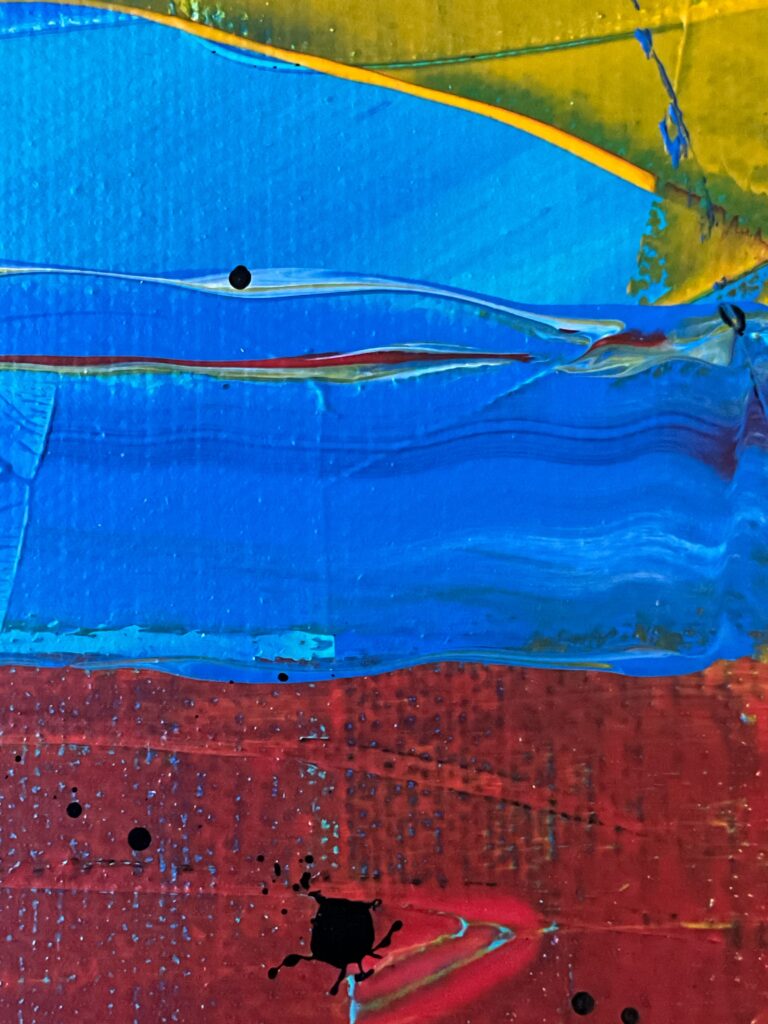
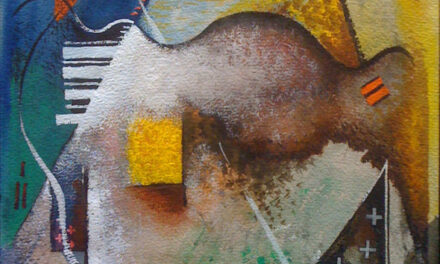
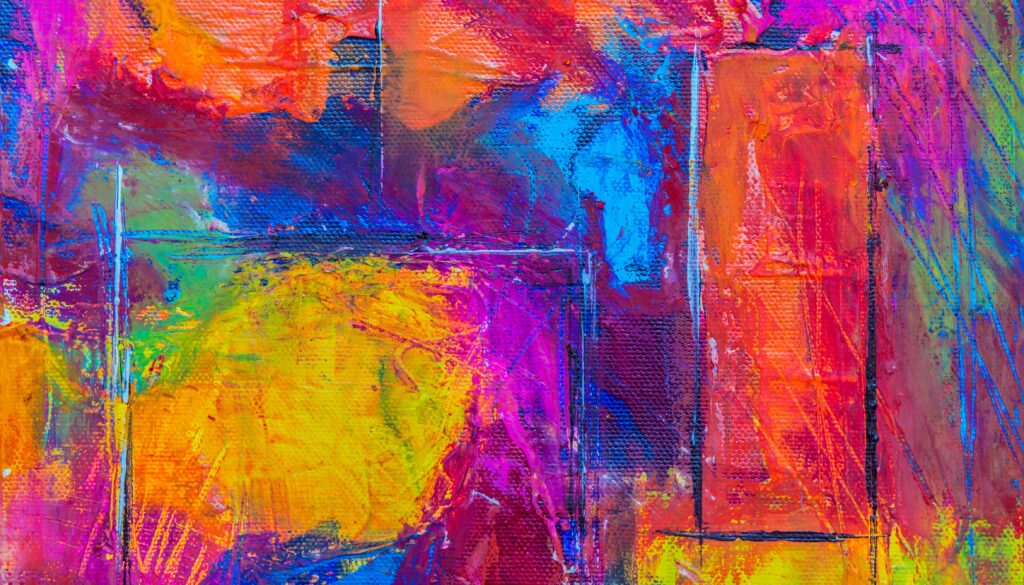
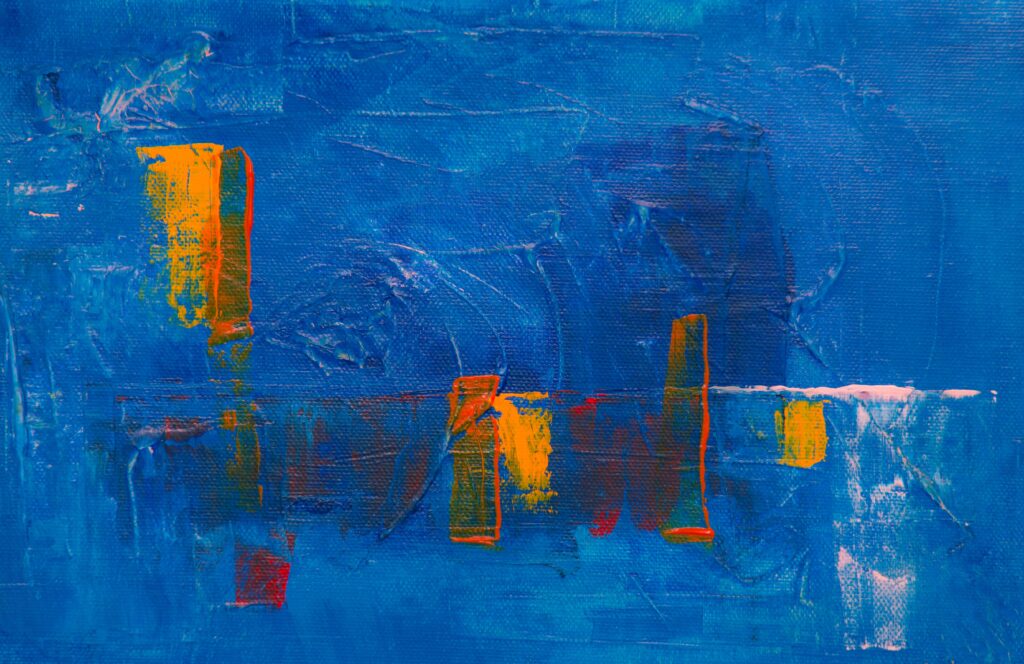
All paintings by Steve A. Johnson
Reprinted from A Map to Mercy, copyright 2025 by Elizabeth Jarrett Andrew, by permission of Orison Books. All rights reserved.